
Articles › Niche Research
How to Find a Profitable KDP Niche in 2026 (Step-by-Step)
Published 23 June 2026 · Updated 1 September 2026 · KDP Metric team
The most expensive mistake in self-publishing has nothing to do with covers or blurbs. It's spending three months writing into a niche that was never winnable in the first place. The page-one books have thousands of reviews, three authors own half the results, and your book settles at rank #900,000 no matter how good it is.
You can see all of this coming before you write a word. Amazon prints the evidence on its own search and product pages, free, and it's current as of today. What most authors lack isn't data. It's a method for reading it. Here's the one we use.
Step 1: Start with a real reader search, not a genre
"Mystery" is not a niche. A niche is whatever a reader actually types into Amazon's search bar, so that's where you start.
- On Amazon, set the search dropdown to Books or Kindle Store.
- Type a seed phrase and pause. The autocomplete suggestions that appear are real searches other people make, ranked roughly by popularity.
- Pick one that's specific enough to mean something. "Cozy mystery bakery" tells you who the reader is; "mystery" doesn't.
Run the search. The results page in front of you is the actual battlefield, and everything in the next five steps is read straight off it or from the books on it.
Step 2: Confirm readers are spending money here
Weak competition means nothing if nobody's buying. A niche with no demand is a trap where you win page one of a search nobody performs.
Open the top few organic (non-sponsored) results and find "Best Sellers Rank" in each Product details block. Lower numbers mean more sales. If the leaders sit in the tens of thousands or better, money moves through this niche. If the so-called winners are languishing past #400,000, walk away now, whatever the competition looks like. There's a full guide to reading BSR here.
While you're there, check publication dates. Books from the last year or two ranking well means the niche is alive now, not coasting on an old back catalogue.
Step 3: Measure the review bar
Reviews are Amazon's visibility currency, and the practical question is simple: how many do the page-one books hold?
Several page-one books under roughly 150 reviews means a newcomer with a decent launch can join them. If every slot holds a thousand-plus, the entry fee is years of accumulated social proof, and no amount of quality shortcuts that.
Don't just average the numbers, though. One 20,000-review megaseller doesn't poison a niche if the rest of the page is reachable. What you're looking for is whether some winnable slots exist.
Step 4: Check who owns the page
Count the distinct author names on page one. Two niches with identical review numbers can be completely different propositions:
- 16 results spread across 14 authors: readers here are open to new names.
- 16 results where 3 authors hold 10 slots: those authors have series momentum, mailing lists and read-through economics working for them, and you'd be fighting all of it from day one.
Series dominance matters too. When most titles read "Book 7 of...", readers in this niche buy series. That doesn't rule the niche out, but it changes what you should write. Plan a three-book arc rather than a standalone.
 Add to Chrome — it's free
Step 5: Look for quality gaps
Saturation is about quality as much as quantity. Scan page one and ask yourself:
- Any covers that are obviously home-made, or unreadable at thumbnail size?
- Descriptions that are thin, generic, or a single unformatted block?
- Ratings sitting below about 4.2 despite decent sales? That's readers buying in and leaving disappointed.
Each yes is a gap you can exploit. The ideal entry point is a niche where demand is proven but a few incumbents are beatable on craft. If everything on page one is polished and rated 4.7, you'll need a genuinely different angle to get noticed.
Step 6: Make sure a winnable category home exists
Most guides skip this step, and it's the one that decides whether you ever get a bestseller badge. Open the books that already rank for your search and read the category lines in their Product details ("#23 in Cozy Animal Mysteries" and so on). You want a specific sub-category that several of the niche's books share, and that's small enough for #1 to be reachable. As a rough model, holding #1 in a mid-sized Kindle sub-category takes around 40 sales a day. In a store-level giant it takes thousands. The full math is here.
If the niche's books only rank in giant top-level categories, there's no realistic badge path. Amazon lets you pick up to three categories per book (KDP's rules), so the goal is one narrow honest fit to lead with and two next-best homes behind it.
The whole checklist at a glance
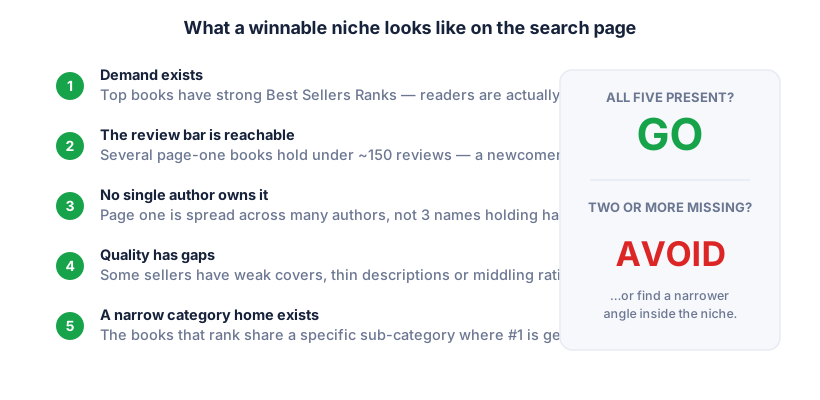
A winnable niche shows all five signals at once. One missing is a judgement call. Two or more missing means walk away, or narrow the angle. "Cozy mystery" may be saturated while "culinary cozy mystery with recipes" sits wide open. Niches fractal down like that, and the narrower angle often costs you nothing more than a subtitle.
A worked example: narrowing until it opens up
Say you want to write a cozy mystery. Search "cozy mystery" and you hit a wall: the page-one books carry thousands of reviews each, a handful of established authors hold most of the slots, and the leaders have been ranking for years. On the checklist that's demand yes, but review bar no and author concentration bad. Two fails. Don't write here.
Now add a word. Search "cozy mystery bakery". The page thins out. Some books still have big review counts, but two or three page-one titles sit under 200, and the author list is more varied. Better, but check the Best Sellers Ranks before you get excited, because a thinner page sometimes just means thinner demand.
Add another dimension. Search "cozy mystery bakery small town" or "culinary cozy mystery cat". Now you're looking at a page where newer books rank, the review floor is genuinely reachable, and the top titles still show healthy BSRs. That's a niche you can enter. The reader who types those longer phrases is telling you exactly what they want, and there are fewer authors serving them.
The point isn't that "bakery" or "cat" is magic. It's that every specific angle you add filters the competition faster than it filters the readers, up to a point. Push too far ("cozy mystery bakery cat vampire librarian") and you filter out the readers too, landing in a niche of one. The sweet spot is the narrowest phrase that still shows real BSRs on page one.
Common mistakes that sink new authors
A few patterns show up again and again, and all of them are avoidable once you know to look:
- Falling for low competition without checking demand. An empty-looking page feels like an opportunity. Often it's just a search nobody makes. Always open a couple of books and read their ranks before celebrating.
- Judging the whole niche by the #1 book. The megaseller at the top is rarely who you're competing with. The books at positions eight through fifteen are your real neighbours, so weigh those.
- Writing to a trend that's already cresting. By the time a trope is all over author forums, page one is full and the early movers have the reviews. Autocomplete and recent publication dates tell you what's rising now, which is more useful than what everyone's already talking about.
- Picking a niche you can't stand. The data can point you somewhere profitable that you have no interest in writing. A book you resent writing usually reads like one. Let the research narrow your options within genres you actually want to work in, rather than override your taste entirely.
One expansion worth knowing about: this checklist isn't limited to the store you already sell in. Now that Kindle Translate has made translation free for eligible eBooks, the German, Spanish, French and Italian stores are worth running these same six steps against — on a book you have already written.
Do you need a tool for this?
Honestly, no. Everything above can be done by hand in twenty or thirty minutes per niche. What a tool buys you is speed and consistency across the ten or twenty niches you should be comparing.
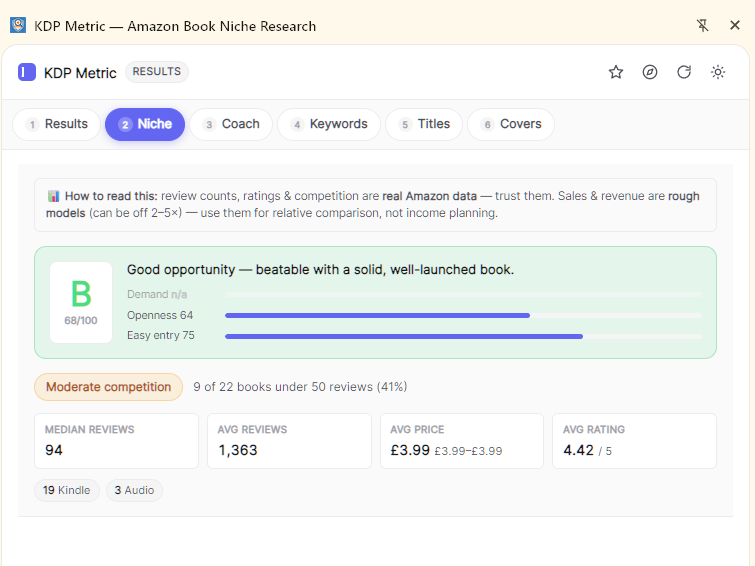
KDP Metric, our free Chrome extension, runs this exact checklist automatically on any Amazon search: the A–F grade, per-book beatability scores, the review bar, author dominance, series share, and the category evidence from books you open, all in a side panel while you browse. The free tier does all of it forever, not as a trial.
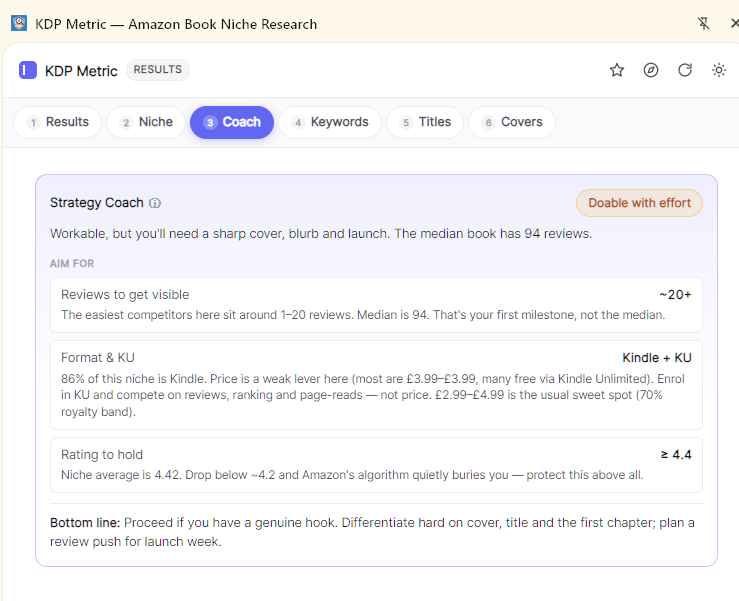
Either way, by hand or with the panel counting for you, the discipline is what matters: judge the niche before you write the book. A few hours of research is cheap insurance on months of writing.
Add to Chrome — it's free