
Articles › Categories
How Many Daily Sales to Reach #1 in an Amazon Category?
Published 8 July 2026 · KDP Metric team
The orange #1 Best Seller badge is the most valuable pixel real estate on Amazon. It follows your book around search results, lifts click-through, and hands shoppers instant social proof. What most authors don't realise is that whether you can win one gets decided largely before launch, by a single choice: which categories you put the book in.
So, the question everyone asks. How many sales a day does #1 actually take?
It depends entirely on the category
There's no single number, because category rank is relative. You need to out-sell whoever currently holds the slot, for long enough for the rankings to catch up (Amazon recalculates at least once a day). The requirement is a property of each category.
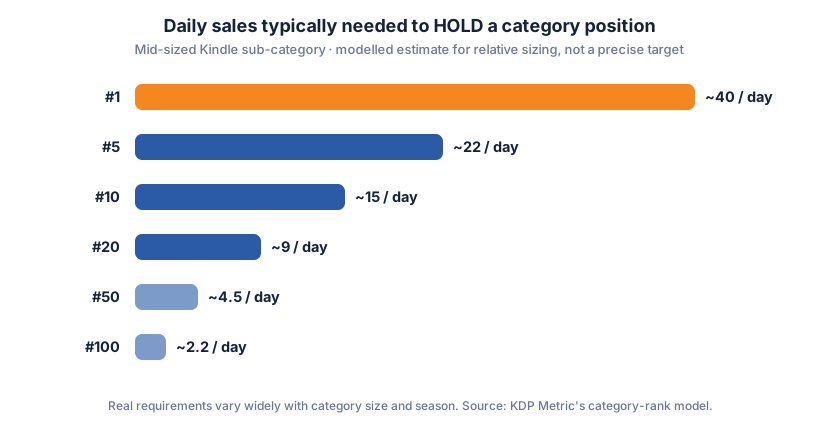
At one extreme sit the store-level giants, like Kindle eBooks › Mystery, Thriller & Suspense, where #1 belongs to household names moving thousands of copies a day. Not your target. The badges indie authors win live in mid-sized sub-categories, and there the numbers look very different. Our working model:
| Position | Est. daily sales to hold it* |
|---|---|
| #1 | ~40 |
| #5 | ~22 |
| #10 | ~15 |
| #20 | ~9 |
| #50 | ~4.5 |
| #100 | ~2.2 |
*Modelled estimates for a mid-sized Kindle sub-category, for sizing the challenge rather than as precise targets. Small niche categories can need far less, big ones far more, and season matters.
Sit with that table for a second. Forty sales a day is a coordinated launch week: a mailing list push, a promo-site slot, maybe some early ads. A well-prepared indie author can genuinely get there. Three thousand a day is another universe. Same badge, same orange pixels. The category choice is the entire difference.
Finding a category you can win
The evidence you need is printed on public pages. Every book's Product details block lists its category ranks ("#23 in Cozy Animal Mysteries"), and those lines tell you two things at once: where books like yours actually live, and how contested each of those lists is.
- Search Amazon for your niche phrase and open the top few organic books.
- Write down each book's category lines. The sub-categories that keep recurring are the niche's real homes.
- For a candidate category, open its Best Sellers list, then open the books sitting at #1 and around #20 and read the Best Sellers Rank from each one's own product page. Run those through the BSR-to-sales curve and you've got the category's entry bar in sales per day. The #1 and #20 on the list are positions within that list, not ranks across the store, so the number you want is only on the book's page.
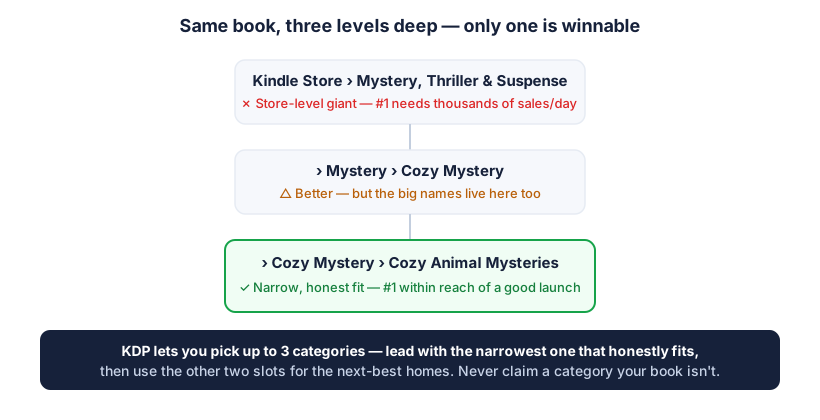
- Prefer the narrowest category that honestly describes your book, where the #1 velocity is within reach of your launch plan.
 Add to Chrome — it's free
The rules, from KDP itself
Worth knowing before you commit, per Amazon's category guidance and the sales-ranking help page:
- You choose up to 3 categories when setting the book up, and you can change them later from your Bookshelf. New selections typically show within 72 hours.
- Your book can display in up to 3 Best Seller category lists, driven by its customer activity.
- Relevance is enforced. Amazon says outright that irrelevant category picks create a poor shopping experience, and that KDP may re-place a book whose category is inaccurate. The old trick of dropping a thriller into some deserted poetry category to farm a badge gets unwound, and readers who click through feel cheated in the meantime.
Reaching a position and holding it are different problems
The sales figures above are for holding a position, and that distinction matters more than it first appears. Reaching #1 for an hour is easy in the right category: a coordinated push on launch day can spike your sales high enough to jump the rankings briefly. Amazon updates ranks at least daily, so a sharp burst can plant your badge.
Holding it is another matter. Because rank reflects recent activity weighted against everyone else's, the badge starts slipping the moment your launch spike fades and the category's steady sellers keep selling. This is why so many authors screenshot a #1 badge on launch day and then watch it vanish within a week. The badge was real, but it was rented, not owned.
For most authors the honest goal is the first version: reach the badge during launch, screenshot it for your marketing and your author page, and understand that the ranking will settle to reflect your ongoing sales. There's nothing dishonest about that as long as you don't imply the book is a permanent chart-topper. If you want a badge that sticks, you need genuine sustained daily sales at the category's holding level, which usually comes from a series with read-through and a mailing list, not from a single title.
What actually concentrates a launch
Since badges are won by density rather than total volume, the mechanics of a launch are worth spelling out. The idea is to compress as many sales as possible into the same short window:
- A mailing list ready before launch. Readers who already want the book, told the day it goes live, are the most reliable spike you can engineer. This is the single biggest reason to build a list from your first book onward.
- A promotion stacked on the same days. Newsletter promo sites, a price promotion, and any ads all pointed at the same 24 to 72 hours rather than spread across a fortnight.
- A launch price that removes friction. Many authors launch a first-in-series low, or free through KDP Select, precisely to maximise the number of readers who act in that window. Lower friction, more simultaneous sales, higher spike.
- A clear single call to action. Every reader you reach should be pointed at the same book on the same day. Splitting attention across formats or asking readers to "grab it sometime this week" spreads the sales thin, which is exactly what you don't want when density is the goal.
None of this changes the underlying number the category demands. It just helps you deliver that number in a tight enough window to jump the rankings while it lasts.
The badge plan, condensed
Pick three categories with evidence behind them: the narrowest honest fit as your badge target, plus the two next-best homes. Size the target by converting the current #1's BSR into daily sales; if it's within about twice what your launch can plausibly generate, it's live. Then concentrate the launch. Badges are won by short, dense bursts of sales in one place, not the same total spread over a quarter. After publishing, confirm the book actually appears where you chose, and adjust from the Bookshelf if it doesn't.
Reading category lines off half a dozen product pages and collating them is tedious by hand, which is why KDP Metric's free Category Finder walks you through the ranked books, reads their Best Sellers Rank lines, and names the narrowest category they share, with the daily-sales estimate for #1 attached. The evidence is Amazon's own. The panel just saves you the notebook.
Add to Chrome — it's free