
Articles › Keywords & Metadata
AI Disclosure on KDP: What Amazon Actually Asks, and What It Does With the Answer
Published 30 August 2026 · KDP Metric team
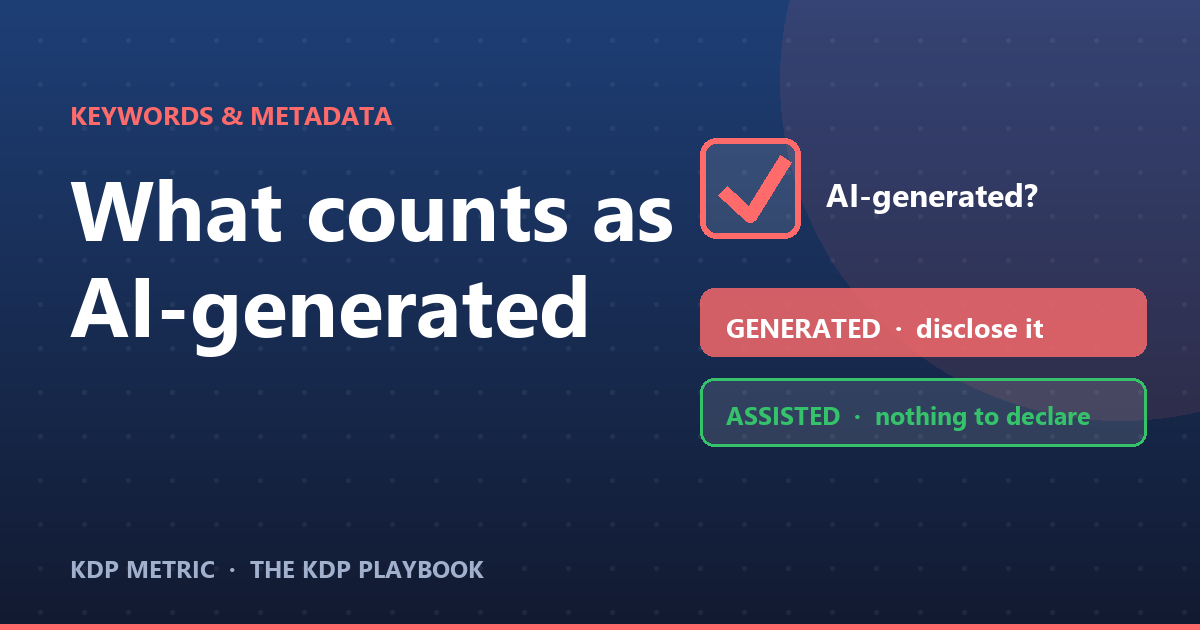
Somewhere in the publishing flow, KDP asks whether your book contains AI-generated content. Authors answer that question nervously and often wrongly — some disclosing a spellchecker, some convinced that ticking the box marks their book for demotion, a few quietly saying no when the honest answer is yes.
The line Amazon draws is narrower and more precise than the anxiety around it, and it's written down. Here's what it says, where the edge cases fall, and — as honestly as it can be stated — what's actually documented about what Amazon does with your answer.
Amazon's two words: generated and assisted
KDP's content guidelines split AI involvement into two categories, and the whole policy hangs on which side of that split your work sits.
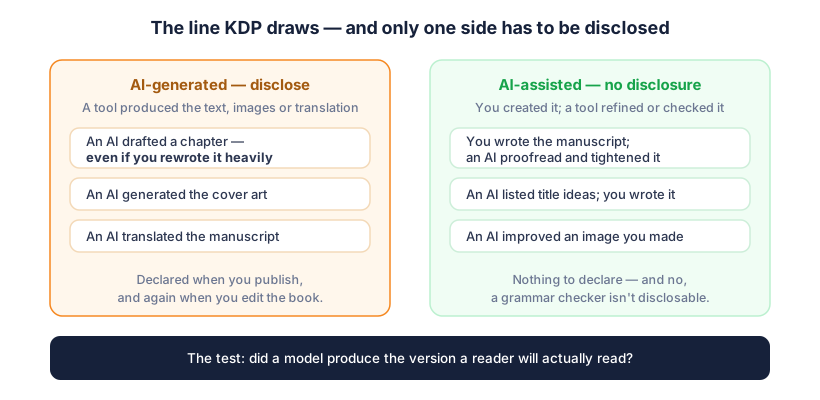
AI-generated is content — text, images or translations — that an AI tool produced. The critical clause, and the one most guides omit: it counts as AI-generated even if you applied substantial edits afterwards. Editing a machine-written draft heavily does not convert it into something else.
AI-assisted is content you created yourself and then used AI tools to refine, edit or error-check — including brainstorming with an AI tool as long as you wrote the final content. Amazon's requirement is asymmetric: AI-generated content must be disclosed; AI-assisted content does not have to be.
The disclosure isn't a one-off at launch, either. You're expected to tell KDP about AI-generated content when you publish a new book and when you edit an existing one.
Where real cases fall
Applying the rule to the situations authors actually find themselves in:
- An AI drafted a chapter and you rewrote it heavily — AI-generated. Disclose. The "substantial edits" clause exists precisely to close this gap.
- You wrote the manuscript; an AI tool proofread it and suggested tighter phrasing — AI-assisted. No disclosure required.
- An AI tool generated your cover art — AI-generated. Images are named in the policy alongside text; a machine-made cover is as disclosable as a machine-made chapter.
- You asked an AI for twenty title ideas, then wrote your own — AI-assisted. Brainstorming is explicitly on the assisted side.
- An AI translated your book into another language — AI-generated. Translations are named in the policy too.
- An AI generated your ad copy and social posts — that isn't content inside the book. KDP's guidance is written in terms of the content you publish, and doesn't spell out where marketing material sits, so the workable rule is the simple one: if it's in the book, disclose it; if it's promotion, the question doesn't arise.
 Add to Chrome — it's free
What Amazon does with the answer
Here's where an honest article has to be careful, because there is less documentation than the confident blog posts imply.
What is documented: the disclosure is required, it applies at publishing and at editing, and you remain fully responsible for making sure AI-generated and AI-assisted content complies with all the content guidelines — including intellectual property rights. That last point does real work. "The model produced it" is not a defence if what it produced infringes someone's copyright; the liability stays with the publisher of record, which is you.
The policy also arrived with a companion measure. Amazon announced the disclosure requirement on 7 September 2023, and — as reported by the Authors Guild, which had been pressing KDP on exactly this — capped the number of new titles an account can create at three per day later that month. KDP confirmed that figure to the Guild and said it could be adjusted if necessary, so treat it as the current shape of the rule rather than a permanent constant. The cap isn't an AI rule as such. It's a volume rule, aimed at the flood of mass-produced titles that AI made cheap, and it catches anyone publishing at that pace regardless of how the books were written.
What is not documented is the part authors most want to know: Amazon does not publish what the disclosure feeds into, and there's no official statement that a disclosed book is ranked, promoted or surfaced differently. Anyone telling you that ticking the box costs you visibility is describing a mechanism Amazon has never described. That's the same standard the rest of this site applies to ranking claims in general: documented, observable, or folklore — and this one is folklore until someone shows the documentation.
What the policy is not
It is not a ban. Amazon has not prohibited AI-generated books; it has required that they be declared, and that they meet the same content guidelines as everything else.
It is not a trap for ordinary tools. Grammar checkers, line-editing suggestions and idea generation are all on the assisted side, which needs no disclosure at all. A lot of authors are disclosing work that Amazon's own definition says they don't have to.
And it is not something to answer creatively. Accurate declarations are part of the guidelines you accepted when you opened the account, which makes a false one an account-level matter rather than a per-book one — a poor trade against a disclosure that carries no documented penalty of its own.
The part that actually affects your sales
The disclosure question is compliance, and compliance is cheap: answer it accurately and move on. The commercial consequence of the AI wave shows up somewhere else entirely — in how quickly a niche fills with near-identical titles, and how much harder that makes it to tell a genuinely open niche from a crowded one that merely looks quiet on a result count.
That's a research problem, not a policy one, and it's the one worth your attention: the six signs of a saturated niche matter more now than they did three years ago. KDP Metric's free Niche Grade reads the competition on any Amazon search page — review depth, rank spread, who owns page one — so a niche stuffed with recent low-effort titles reads differently from one with real, entrenched competitors, before you commit months to writing into it.
Add to Chrome — it's free