
Articles › Keywords & Metadata
How Amazon Decides Which Books to Show: Documented, Observable, and Folklore
Published 27 July 2026 · KDP Metric team
Search "how the Amazon book algorithm works" and you'll be handed a confident list of ranking factors, usually numbered, often with weightings attached. Conversion rate is 30% of the algorithm. Click-through rate matters more than sales velocity. The algorithm is called A9 and it works like this.
Almost none of that is sourced. Amazon has never published a ranking algorithm for books, has never confirmed a weighting for anything, and the "A9" name refers to a subsidiary that was folded into Amazon Ads years ago. The confident numbers are, without exception, someone's guess that got repeated until it hardened.
That's genuinely unsatisfying, so this article does the next best thing: separates the three tiers — what Amazon states in its own documentation, what you can observe and verify yourself on a live page, and what's folklore — and then explains what a reasonable person should do about it.
What Amazon actually documents
There's less than you'd hope, but it isn't nothing. From the KDP help pages on keywords and discoverability:
- Relevant keywords "can boost your placement in search results on the Amazon Store" — placement, not ranking position; a deliberately vague word.
- Placement is influenced by keywords alongside factors including sales history and Best Sellers Rank. That's Amazon confirming that commercial performance feeds discovery, without saying how much.
- Keywords should "accurately portray your book's content and reflect the words customers will use when they search."
- Without quotation marks, your seven keyword phrases are indexed as individual words, so a customer can find your book by searching any of them, in any order.
And a list of what Amazon explicitly tells you not to put in keywords: information already in your other metadata (title, author, category), subjective quality claims like "best novel ever", time-sensitive phrases like "new" or "on sale", generic words like "book", misspellings, other authors' or brands' names used misleadingly, Amazon programme names such as "Kindle Unlimited" or "KDP Select", quotation marks, and HTML tags.
That's the documented set. Notice what's absent: any statement about conversion rate, click-through rate, dwell time, review count, or how any of it is weighted. Nobody outside Amazon knows those weightings, and the people selling you a number don't either.
Anatomy of a results page
Here's the part that pays off immediately, because you can check every word of it yourself in the next two minutes. An Amazon book search page is not one ranked list. It's several different things stacked together, and confusing them is why so much niche research goes wrong.
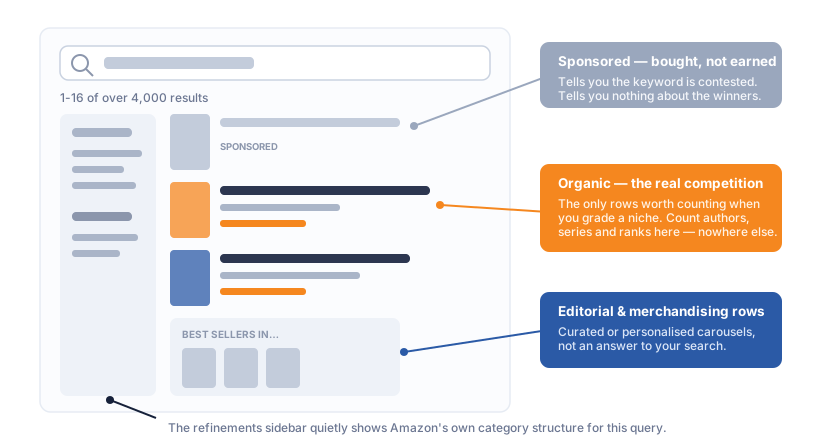
Sponsored placements. Amazon labels them — the small grey "Sponsored" tag above or below the listing. These books are there because someone bid on your search term, not because Amazon judged them relevant or successful. A sponsored slot at the top of page one tells you the keyword is commercially contested, which is useful information, but it tells you nothing about whether that book is beating the competition.
Organic results. The unlabelled listings. These are Amazon's own answer to the query, and they are the only part of the page that describes the actual competition.
Editorial and merchandising rows. "Best Sellers in…", "Recommended based on…", "Highly rated" carousels and brand modules get injected between organic rows, especially on mobile. They're curated or personalised, not ranked responses to your search.
The refinements sidebar. The left-hand filter panel, which quietly tells you Amazon's own category structure for this query — where these books actually live in the store. Under-used, and one of the most reliable category research inputs on the page.
The result count. "1-16 of over 4,000 results". Treat it as a rough magnitude, not a fact — Amazon rounds it, it changes between reloads, and it counts everything loosely matching, not everything competing. It's the single most over-quoted number in KDP research.
If you take one thing from this article: when you assess a niche, count only the organic rows. A page-one full of sponsored ads is a page-one you haven't actually seen yet.
 Add to Chrome — it's free
What you can verify yourself
You don't need Amazon's algorithm to do good research. You need to be able to read the page in front of you, and everything below is checkable in a browser without any tool at all.
Search personalises. Search a term while signed in, then again in a private window. The lists usually differ. This matters more than it sounds: the "page one" you've been staring at may be partly your own browsing history reflected back at you. Do competitive research signed out, or in a private window, and you'll get a cleaner read.
Results differ by marketplace. Amazon.com and Amazon.co.uk are separate stores with separate catalogues, separate rankings and quite different competitive density. Researching a UK launch on the US store is a common and expensive mistake.
Autocomplete is real demand data. The suggestions that drop down as you type are derived from what customers actually search for. That's the closest thing to first-party demand data that Amazon exposes for free, and it's worth mining deliberately.
Ranks are the honest signal. Amazon does publish Best Sellers Rank on every product page, and it updates at least daily. A niche's page-one ranks tell you what's selling right now, which is a far more reliable input than any theory about weightings.
Folklore worth discarding
"The algorithm is called A9 and it works like [diagram]." A9.com was an Amazon subsidiary that worked on search and advertising technology, and it was absorbed into Amazon's advertising business years ago. Book search today is not a documented system anyone outside Amazon can name, let alone diagram.
"You get a 30-day honeymoon boost." No Amazon documentation supports this. New books do often sell better in their first weeks — because that's when the author is promoting, the launch list is firing, and the pre-order backlog converts. Attributing your own launch effort to a secret algorithmic gift leads to genuinely bad decisions in month two.
"Repeat your keywords in the description to rank for them." Amazon's metadata guidelines explicitly prohibit keyword phrases in the description, and stuffing produces the one thing that definitely hurts you: a description that doesn't sell the book to the human reading it.
"Sales in the first 24 hours determine your rank forever." Amazon documents the opposite — rank reflects recent and historical activity, with recent weighted more heavily. That's a rolling measure by definition. A strong day one is nice. It doesn't lock anything in, and rank is relative anyway.
What to actually do about it
The useful conclusion from all this is not "the algorithm is unknowable, so give up." It's that the inputs you can control are exactly the ones Amazon documents, and they're mostly unglamorous.
Put honest, reader-language keywords in your seven slots, using terms you've checked in Amazon's own search box rather than terms you assume. Pick categories where your book genuinely belongs and can actually rank. Write a description that converts a browser into a buyer, because conversion is the one factor everyone agrees matters even though nobody can quantify it. And then judge the results by what changes on the page and in your reports — not by a theory of what the machine is thinking.
Research the observable. Ignore the numbered lists. The authors doing well in your niche got there by being visibly and specifically right for a search someone typed, and you can read the evidence for that on any results page, for free, today.
Add to Chrome — it's free