
Articles › Fixing a Stuck Book
Your Book Description Has 4,000 Characters and About Two Seconds
Published 24 July 2026 · Updated 25 August 2026 · KDP Metric team
If your book is getting traffic and not selling, the description is the most likely culprit and the cheapest thing to fix. You can rewrite it this afternoon, it costs nothing, and it takes a few hours to go live. Compare that to a new cover, or a new book.
It's also the piece of metadata authors put the least thought into, usually because by the time they reach that field they've been formatting a manuscript for six hours and just want to be finished. So they paste in a summary of the plot, hit publish, and never look at it again.
A summary of the plot is not a description. Here's what the field actually is, what Amazon will and won't allow in it, and a structure worth stealing.
The technical constraints
4,000 characters maximum — and the HTML counts. This is the detail that catches people. If you bold a line with <b></b>, those seven characters come out of your 4,000. A heavily formatted description can burn a couple of hundred characters on markup alone.
Basic HTML is supported. The reliable tags are <b> for bold, <i> for italic, <br> for a line break, <p> for paragraphs, and <ul>, <ol> and <li> for lists. KDP's own description editor will apply these for you if you'd rather not hand-write them.
Pasting from Word breaks things. If your description renders on Amazon with visible tags, stray symbols or all the formatting collapsed, it's almost always invisible HTML that came along with a copy-paste. Paste into a plain text editor first, then into KDP.
What Amazon prohibits
These aren't guidelines, they're the Metadata Guidelines for Books, and Amazon does enforce them — sometimes by rejecting the update, sometimes by suppressing the listing later. The description must not contain:
- Contact information — phone numbers, postal addresses, email addresses or website URLs. This includes your own author site.
- Reviews, quotes or testimonials, and requests for customer reviews. Yes, this includes the glowing line from a blogger. Editorial reviews have their own field in Author Central; that's where they belong.
- Advertisements or promotional material, including watermarks on images or video.
- Time-sensitive information — dates of tours, seminars, launches or events.
- Availability, price, or alternative ordering information, including links to other retailers.
- Spoilers.
- Keyword phrases or book tags. The stuffed keyword paragraph at the bottom of a description is explicitly against the rules, and it doesn't work anyway.
- Pornographic, obscene or offensive content.
That list quietly rules out about half of what gets recommended in self-publishing Facebook groups. The "★★★★★ 'A gripping read!' — Book Blog" opener that so many indie descriptions use is a straightforward violation.
The fold is the whole game
Amazon truncates the description on both mobile and desktop and hides the rest behind a "Read more" link. On a phone — where a large share of Kindle browsing happens — that means a couple of lines are visible before a reader has to make a deliberate decision to see the rest.
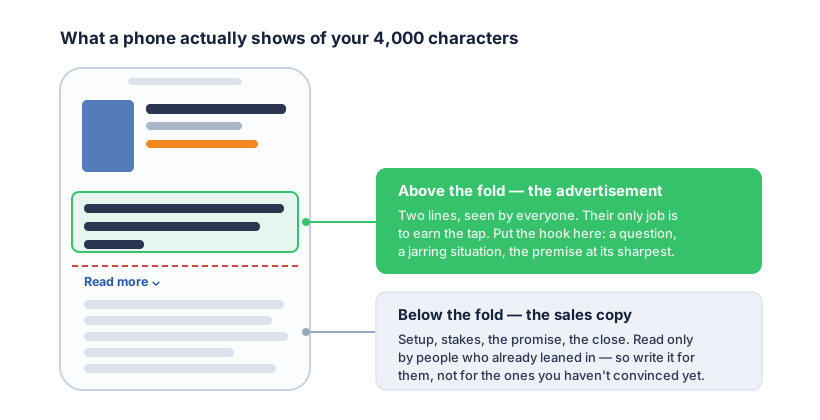
So the description is really two documents. The first two lines are an advertisement whose only job is to get the tap. Everything after them is the actual sales copy for a reader who has already leaned in.
Most descriptions get this exactly backwards, opening with setup — "In the sleepy village of Ashcombe, where nothing much has happened since the war…" — and putting the hook in paragraph three, where nobody on a phone will ever see it.
Front-load. Whatever is most likely to make a stranger curious goes first, in a sentence short enough to survive truncation.
And when the description runs out, the page doesn't. Further down sits a second block — From the Publisher, otherwise known as A+ Content — which is free on every KDP book, empty on most of them, and the right home for the detail that has no business competing for space above the fold.
 Add to Chrome — it's free
A structure that works
This is a shape, not a template — the point is the order of operations, not the wording.
1. The hook (one or two lines). A question, a jarring situation, or the premise stated at its most interesting. This is the part that must survive the fold. Short sentences. No proper nouns the reader hasn't met yet.
2. The setup (two or three sentences). Who this is about and what their normal was. Just enough for the stakes to land — a reader doesn't need the map, the political system or the names of three secondary characters.
3. The disruption and the stakes. What goes wrong, and what it costs if it isn't fixed. This is the engine of the whole thing. Vague stakes ("she must confront her past") are the single most common failure in indie fiction descriptions, because they could describe any book ever written.
4. The promise. What kind of experience is being offered. This is where genre signalling lives, and it's genuinely important: readers of cosy mystery, dark romance and grimdark fantasy want quite different guarantees, and a description that doesn't signal clearly attracts the wrong readers and earns two-star reviews from people who wanted something else.
5. A close. One line. "Perfect for readers of X and Y" is a cliché because it works — it tells a browser which shelf they're standing in front of. Then stop.
For non-fiction the shape changes but the logic doesn't: lead with the problem the reader has, not with your credentials. Name the outcome. Then use a short bulleted list of what's inside — non-fiction is the one place where <ul> earns its characters, because a buyer is scanning for whether their specific problem is covered. Credentials go near the end, briefly, as reassurance rather than as the pitch.
How to tell whether yours is working
You can't A/B test on Amazon — there's no split-testing tool — so you're left with two honest approaches.
Change one thing and watch. Rewrite the description, leave everything else alone, and compare a full month of sessions and units in your KDP reports against the month before. It's slow and noisy, but if the change is real it shows up.
Read it against the competition. Open the top five organic results for your main keyword and read their descriptions in sequence, then read yours in the same sitting. This is uncomfortable and extremely informative. You will usually find that the winners are more specific than you are, promise a clearer experience, and get to the hook faster.
That second exercise is worth doing even if you think your description is fine. The reader isn't judging your book in isolation — they're judging it against the nine other covers on the same screen, in the two seconds before they scroll. Your description isn't competing with a blank page. It's competing with theirs.
Add to Chrome — it's free