
Articles › Niche Research
Kindle Translate: Five New Stores, Free — and the Three Things It Won't Do
Published 1 September 2026 · KDP Metric team
Translation used to be the wall that separated most self-published authors from the non-English Kindle stores. A professional translation of a novel costs more than most indie titles earn in their lifetime, so the German, Spanish and Italian stores stayed theoretical — visible in the marketplace dropdown, never actually entered.
Amazon has removed the cost. Kindle Translate translates KDP eBooks for free, and the interesting part isn't the translation itself. It's that it hands you five language markets you have never researched, on a book you have already written — which turns a writing problem into a niche research problem, and that one is solvable.
What it is, precisely
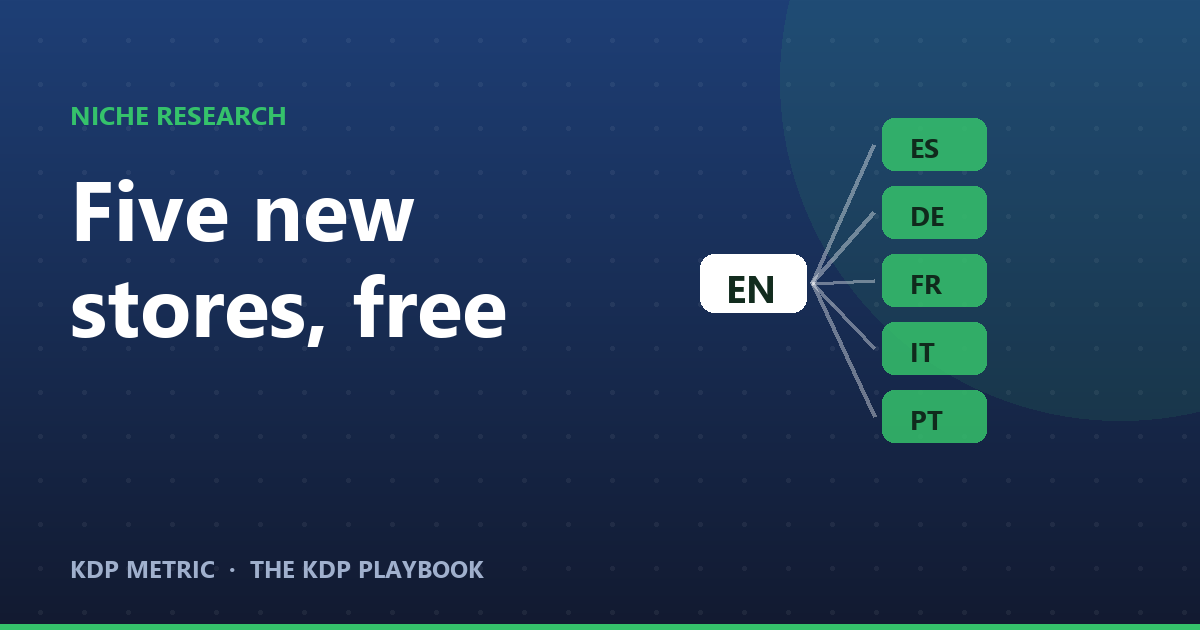
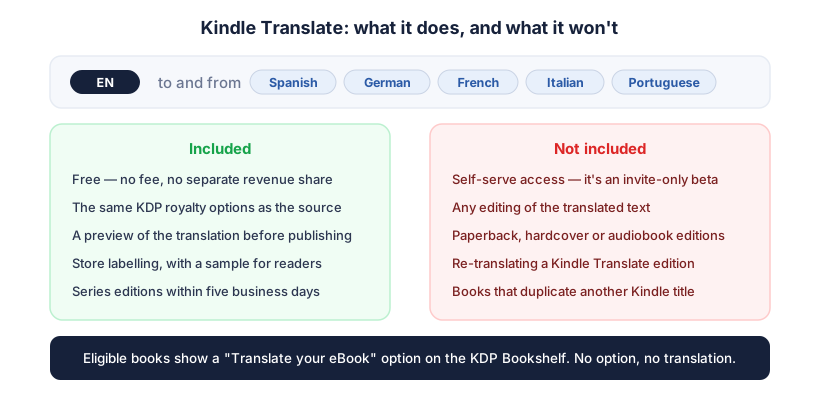
Kindle Translate launched on 6 November 2025 and was expanded on 30 June 2026. It now handles translations between English and Spanish, German, French, Italian and Portuguese, in both directions.
The mechanics, from KDP's own Kindle Translate page and Amazon's announcement:
- It's free. There's no fee and no revenue share peculiar to translations — you get the same KDP royalty options on a translated edition as on the source eBook.
- Every translation is quality-checked automatically before publication, and you can preview it before it goes live rather than publishing blind.
- Readers are told. Kindle Translate titles are clearly labelled in the Amazon store, and shoppers can read a sample of the translation before buying.
- Series are handled. Translate the eBooks in an existing series and Amazon creates the new language edition's series within five business days of the translations going live.
Amazon says thousands of authors have used it so far, that customers have read millions of pages of translated titles, and that those titles average 4+ stars.
The three things it won't do
This is a beta, and the site's usual rule applies: the limits matter more than the headline.
It's invite-only. You don't apply and you don't opt in — if your eBook is eligible, a Translate your eBook option appears on that book's entry in your KDP Bookshelf. No option, no translation. If a book isn't eligible, KDP's eligibility page points you at a Why isn't my eBook eligible? link on the Bookshelf that names the requirement it missed — and Amazon reserves the right to decide which books it takes into the beta at all. Its own guidance is that the service works best on fiction and narrative non-fiction, which is a fair hint about where the technology is confident.
You can't edit the translated text. You can preview it; you cannot correct it. KDP's page states plainly that direct editing of the translated text isn't available at this time. For a plot-driven novel that's usually tolerable. For anything where a specific term must be exactly right — a technical manual, a legal or medical guide, a book built on wordplay — being unable to fix a single word is a real constraint, not a footnote.
It's eBooks only. No paperback, no hardcover, no audiobook, and a book already created through Kindle Translate can't be run through it again.
 Add to Chrome — it's free
The question to answer before you translate anything
A translated edition doesn't land in your market. It lands in a different store, with different competition, different pricing norms and a different set of books already holding page one — and none of what you learned about your English niche automatically transfers.
So run the same checks you'd run on any new niche, in the target store rather than your own:
- Search your core term in that marketplace — amazon.de, .es, .fr or .it — and read page one the way the niche-finding method describes. Result counts tell you nothing; who holds the top rows tells you everything.
- Check whether page one is native or translated. A German-language category dominated by books originally written in German is a different proposition from one where the bestsellers are themselves translations of English titles — the second is a market that already buys books like yours.
- Look at review depth in that store, not yours. Non-English stores are frequently smaller, which cuts both ways: fewer competitors, but also a lower ceiling. A category where the top books hold 40 reviews is a genuinely different opportunity from one where they hold 4,000.
- Apply the saturation checks locally. The six signs work in any language, because they're read off the page rather than off the words.
What a translation doesn't fix
Two things worth saying before anyone treats this as a rescue plan for a stuck book.
A translated edition is a separate listing with its own review count, starting at zero. It inherits your source book's text and nothing else — not its reviews, not its rank history, not its category placements. Everything about how many reviews a book needs to look credible starts again from scratch in the new store.
And if the English edition isn't selling, translation is the wrong lever. A weak cover is weak in every language; a blurb that doesn't convert doesn't convert in Spanish either; a niche with no readers in it has no readers in it abroad. Work through why the book is stuck first — translation multiplies whatever the book already does, including nothing.
If you get the invite
Take one book, not the whole catalogue. Pick the title that performs best in English, in the language whose store your research says is genuinely receptive, preview the translation properly, and treat the result as a new launch in a new market — its own categories, its own keywords, its own price for that store's norms.
Then judge it on that store's data rather than on the excitement of having a book in German. That's the same discipline every other decision on this site asks for; the only thing that's changed is that the cost of entry went to zero.
KDP Metric works across twelve Amazon marketplaces — including amazon.de, .fr, .es and .it, four of the five Kindle Translate target languages — so the same free Niche Grade, competition table and category data you use at home read the German or Spanish store the same way, before you translate a word.
Add to Chrome — it's free