
Articles › Niche Research
Who Owns Page One? Series, Author Dominance and the Real Barrier to Entry
Published 27 July 2026 · KDP Metric team
"There are 8,000 results for this keyword, so it's too competitive." You'll see that reasoning constantly, and it's close to useless. Amazon's result count is a rounded, loosely-matched magnitude that includes books which barely relate to the query and will never appear anywhere near a reader. Nobody is competing with result number 4,312.
You're competing with page one. And the question that actually decides whether you can win it isn't how many books exist — it's who owns the slots, because ten books by seven different authors and ten books by one author are the same number and completely different problems.
Three page-one patterns, and what each one costs you
Look past the titles for a moment and read page one as a distribution. Almost every niche falls into one of three shapes.
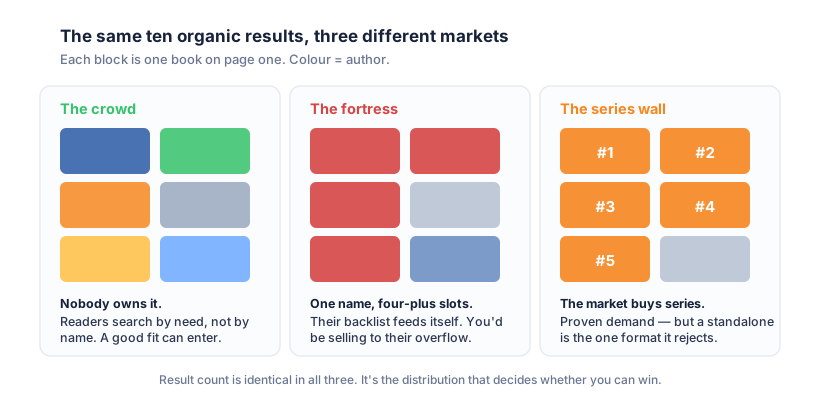
The crowd. Ten organic results, nine or ten different authors, no repeated series. Nobody has locked the niche down. Readers here are searching by need rather than by loyalty, which means a new book that genuinely fits the query can enter on merit. This is the pattern you want, and it's more common than pessimists claim — particularly in specific non-fiction and in fiction sub-niches described by situation rather than by trope.
The single-author fortress. One name takes four, five, six of the ten slots. This is the hardest pattern to break, and the reason is behavioural rather than algorithmic: readers in that niche have learned to search for the thing and find that author. Their backlist reinforces their backlist. Every book they publish makes the next one easier to find, and every one of your books starts from zero. You can still sell here, but you're selling to their overflow, not to the niche.
The series wall. Consecutive slots belong to books one through six of the same series. Slightly better news than the fortress, because the reader's loyalty attaches to a story rather than a byline, and readers who finish a series are actively looking for the next thing. But a standalone entering a series-dominated niche is at a structural disadvantage. Series readers want more of the same, at length, and they can tell from your cover that you're not offering it.
How to count it in five minutes
No tool required, though this is exactly the mechanical counting a tool should do for you.
- Search the niche in a private window, signed out. Amazon personalises results, and you want the market's page one, not yours.
- Ignore everything labelled Sponsored. Those slots were bought. They tell you the keyword is commercially contested — useful — but they say nothing about who is winning organically.
- Write down the author name for each of the ten organic results. Count repeats. That's your author dominance figure.
- Note which results are part of a series — look for "Book 3 of 7" under the title, or a series name in the title. Count them. That's your series share.
- Note the publisher on two or three of them. Product details lists it. "Independently published" means an indie; an imprint name means a traditional publisher with a marketing budget and a sales team.
Then read the result like this:
- Author dominance at or above 40% — one name holding four or more slots — treat the niche as owned. Not impossible, but you're taking on an incumbent with an established readership, and you should have a specific reason to think you can.
- Series share above 60% — the market wants series. Don't enter with a standalone.
- Traditional publishers holding most of page one — this usually signals a niche with real money in it and professional competition. Money is good news. The competition is not, and it's a poor first-book choice.
 Add to Chrome — it's free
The signal hiding in review counts
Once you know who owns the slots, one more number sharpens the picture considerably: reviews relative to how long the book has been on sale.
A book with 2,000 reviews that published in 2019 has been accumulating slowly for years. That's an entrenched title, but it isn't necessarily a fast-moving one, and a review count that large mostly reflects time rather than current momentum.
A book with 300 reviews that published four months ago is a different animal entirely. It is selling hard right now, and it's still climbing. A page one full of those is a niche in the middle of a boom — which means real demand and probably several other authors who have already noticed.
The publication date sits in the Product details block on every book page, next to the rank. Checking it on the top three results takes a minute and changes how you read everything else. Two niches with identical average review counts can be a dying backlist and a live gold rush, and the only thing distinguishing them is the dates. How many reviews you'd need to compete is a related question, and the answer depends heavily on which of those two you're looking at.
What to do when the niche is owned
Finding out that a niche belongs to somebody isn't a wasted afternoon. It's the answer you were looking for, and it points somewhere.
Go narrower, not elsewhere. A fortress author usually dominates the broad term and leaves the specific ones alone. If one name owns "cozy mystery", nobody owns "cozy mystery bookshop small town" — and the reader typing the longer phrase knows exactly what they want and is far easier to satisfy. Amazon's own autocomplete will hand you those phrases if you ask it properly.
Find the gap in the format. If page one is all series, a series is the opportunity, not a barrier — the demand is proven and the incumbent can only publish so fast. If page one is all 400-page tomes and readers keep saying "too long" in the three-star reviews, there's a shorter book to be written.
Check the neighbouring category. Books rank in up to three categories, and the one they're competing in isn't always the one you searched. The refinements sidebar on the results page shows where these books actually live, and a category one step sideways can be dramatically less contested for a nearly identical reader.
Or just accept the verdict. The most valuable outcome of niche research is the niche you decide not to write. A month spent finding out the market is closed is a lot cheaper than a year spent proving it.
None of this requires a subscription or a database. It requires looking at page one as a structure rather than a list, counting three things, and being willing to believe what the count says even when you'd already fallen in love with the idea. That last part is the hard one.
Add to Chrome — it's free