
Articles › Comparisons
Free KDP ISBN or Buy Your Own? The Decision, Without the Sales Pitch
Published 27 August 2026 · KDP Metric team
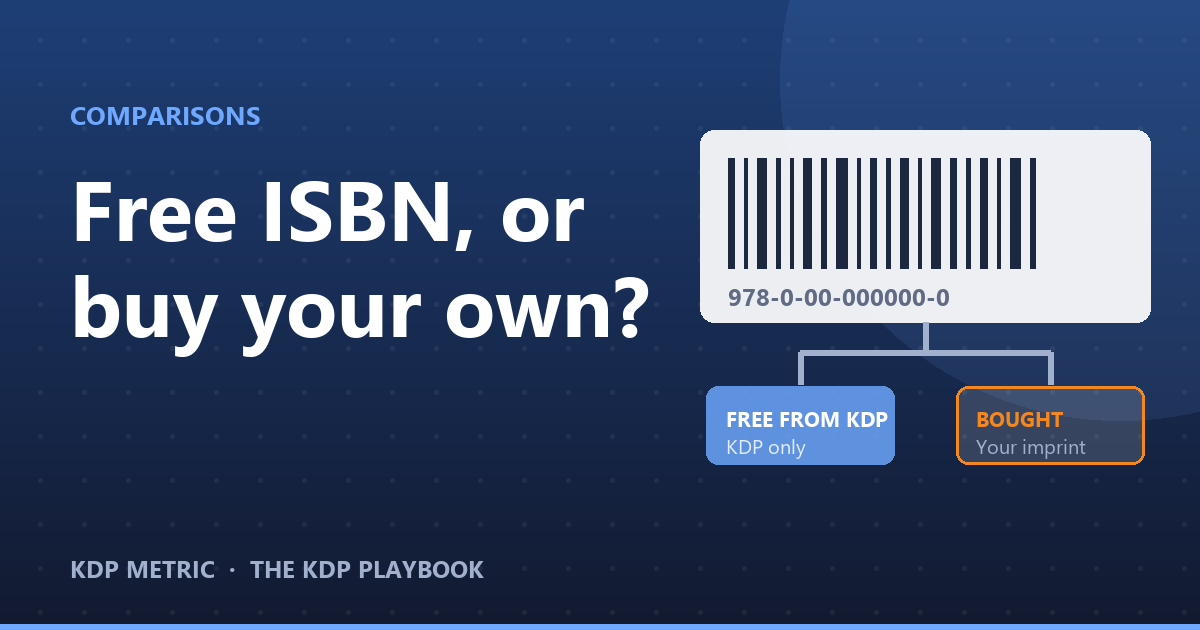
Ask whether to use KDP's free ISBN and you'll get two confident answers. One says free ISBNs are a trap that brands you an amateur forever. The other says ISBNs are a racket and Amazon's free one is fine. Both are arguing about identity and neither is answering the question, which is narrower and much easier: is this edition ever going to be printed by anyone except KDP?
Everything else follows from that. Here's the mechanics underneath it, sourced from KDP's own ISBN and imprint page.
First: your eBook almost certainly doesn't need one
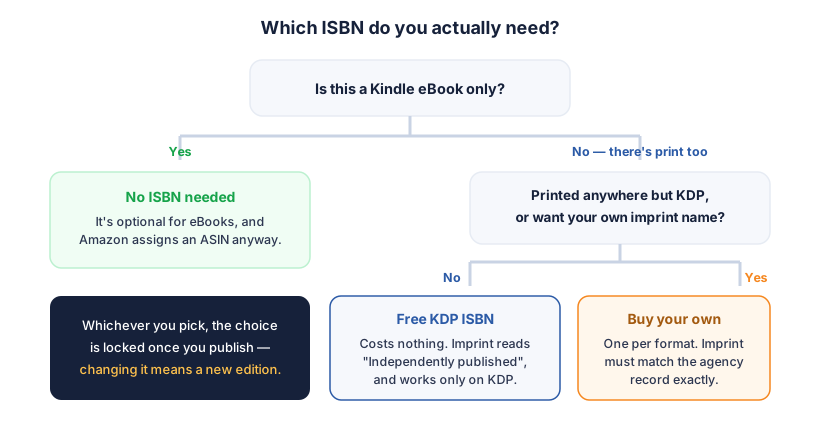
Before the comparison, the part that removes the decision entirely for a lot of authors. KDP's page is explicit that eBooks and low-content books are the only formats where an ISBN is optional — and for a Kindle eBook, Amazon identifies the listing with an ASIN instead, generated automatically when you publish.
So if you're publishing a Kindle edition and nothing else, you can stop reading here: you don't need to buy anything, you don't need to accept anything, and the ISBN field isn't a decision you have to make. The debate only becomes real when you add a paperback or hardcover, where an ISBN isn't optional — you either take KDP's or supply your own.
What the free KDP ISBN actually is, and isn't
It's a genuine ISBN, assigned at no cost, and it does the job an ISBN does inside Amazon's ecosystem. Two consequences come attached, and they're the whole story:
Your imprint shows as "Independently published." That's the publisher name a shopper sees in the product details, and you can't replace it with your own imprint while using a KDP-supplied number.
It can only be used on KDP. In KDP's words, free ISBNs from Amazon can't be used to publish outside KDP. That does not lock your book anywhere — you're free to publish the same title through IngramSpark, Draft2Digital or anyone else — but that edition needs a different ISBN, because this one doesn't travel.
 Add to Chrome — it's free
What buying your own gets you
One thing, mainly: the imprint line becomes yours. You register the ISBN to your own publishing name, and that name appears on the listing instead of "Independently published". You also own a number that works on every platform, which matters the moment you want the same print edition available through more than one printer.
There's a strict condition attached that trips up more first-timers than any other part of this process. When you supply your own ISBN, KDP checks your imprint against the record held by the ISBN agency you bought from, and if the two don't match, you can't publish. That check is literal — it's case-sensitive, and even a trailing space in the imprint field will fail it. If the name you registered with the agency is Harbour Lane Press, that's the string, exactly, that goes in KDP.
Where you buy one, and why the price isn't the same for everyone
ISBNs are issued by a national agency, and which one you use depends on where you live rather than where you sell. In the United States that's Bowker; in the UK and Ireland, Nielsen; in Australia, Thorpe-Bowker. The International ISBN Agency lists the appointed agency for every country, and that list is the one to trust.
This is worth checking before you reach for a card, because the economics differ wildly by country. In Canada, ISBNs are issued free by Library and Archives Canada — a Canadian author agonising over whether to pay for one is agonising over nothing. In countries where they are sold, single numbers cost far more per unit than a block does, which is what makes the decision awkward for a first-time author: buying one is poor value, and buying ten is a bet on writing ten formats.
Buy from your national agency or an agency-appointed reseller. An ISBN bought through a publishing service that registers itself as the publisher is not your ISBN, whatever the sales page implies — the imprint on file is the thing that matters, and that's the thing KDP checks.
The part that makes this a one-shot decision
Here's the detail that turns a preference into a decision worth ten minutes: the ISBN choice is locked when you publish. It sits in the same category as language and edition number — fields you can't edit afterwards on a live listing. Switching from a free KDP ISBN to your own later isn't an edit; it's a new edition, which means a new listing, a new ASIN and a review count starting at zero.
One more asymmetry worth knowing before you choose, because it's often mis-stated: Expanded Distribution — the channel that reaches bookshops, libraries and other online retailers — is available for paperbacks only. KDP's distribution page says plainly that it isn't available for hardcover. So the "but I want bookshops to stock it" argument, whichever ISBN you pick, applies to your paperback and not to your hardcover.
So, which one?
Take the free KDP ISBN if this print edition will only ever be printed by KDP, and you're relaxed about "Independently published" appearing in the product details. That's most first books, and it costs nothing to be wrong in a small way here — the listing sells identically either way.
Buy your own if any of these is true: you want your imprint name on the listing, you intend to print the same edition through another platform as well, or you're building a catalogue where a consistent publisher name across many titles is part of the plan. Then buy for the formats you'll actually publish, not for the ones you might.
What doesn't belong in the decision is the idea that readers judge the publisher line. They overwhelmingly don't — they judge the cover, the description, the reviews and the price. If your print book isn't selling, the ISBN on it is the last place to look, and the 10-point diagnostic covers the places worth looking first. When you're ready to check whether the niche itself is the problem, KDP Metric's free Niche Grade reads the competition on any Amazon search page and tells you what you're actually up against.
Add to Chrome — it's free