
Articles › Comparisons
Kindle eBook vs Paperback vs Hardcover: What Each Format Actually Pays
Published 13 August 2026 · Updated 12 September 2026 · KDP Metric team
Most authors work out their eBook royalty to the cent and never touch the paperback numbers at all, because the paperback dashboard shows a "royalty" figure that looks close enough to make sense of at a glance. It isn't quite as simple as it looks, and hardcover is a different formula again. All three formats are worth pricing on purpose rather than by feel, because the gap between doing it right and guessing is real money, on every single copy, forever.
Here's what each format pays, and the one tier change from June 2025 that a lot of older advice online still gets wrong.
The eBook number, quickly
The 70%/35% royalty split, the $12.99 ceiling Amazon added in July 2026, and the delivery-cost deduction all live in a full article of their own. The short version for comparison purposes: a 2MB novel at $4.99 nets $3.28 a copy at the 70% rate, after the $0.15/MB delivery fee.
Paperback and hardcover don't have a delivery fee. They have something else instead: a physical printing cost, subtracted before you see a royalty at all.
The formula that's the same for both print formats
KDP states it plainly, and it's the same shape for paperback and hardcover alike:
The part that catches people out is the royalty rate itself. Until June 2025 it was a flat 60% on both formats, and a lot of the pricing advice still circulating online was written for that world. Since 10 June 2025, both paperback and hardcover pay a two-tier rate: 60% at or above a marketplace threshold ($9.99 on Amazon.com), and only 50% below it. Price a book at $9.98 instead of $9.99 and you don't lose a cent of list price, you lose ten points of royalty rate.
Printing costs, in real numbers
For a standard black-ink book on regular paper, Amazon.com's rates work out to:
| Format | Fixed cost | Per page (110+ pages) |
|---|---|---|
| Paperback | $1.00 | $0.012 |
| Hardcover | $5.50 | $0.012 |
Same per-page rate, very different fixed cost — a hardcover's binding and boards cost $4.50 more before a single page is counted. Colour interiors cost far more per page (roughly $0.065–$0.07 for premium colour, against $0.012 for black ink), which is why a heavily illustrated book behaves completely differently from a novel in this maths, in both eBook file size and print ink cost.
 Add to Chrome — it's free
Worked example: the same 300-page novel, three ways
Take a plain 300-page black-ink novel and price each format the way authors typically do — an eBook at a KU-friendly price, a paperback slightly above it, a hardcover as the premium option.
| Format | List price | Rate | Printing/delivery cost | Royalty per copy |
|---|---|---|---|---|
| eBook (2MB) | $4.99 | 70% | $0.30 delivery | $3.28 |
| Paperback | $12.99 | 60% | $4.60 printing | $3.19 |
| Hardcover | $24.99 | 60% | $9.10 printing | $5.89 |
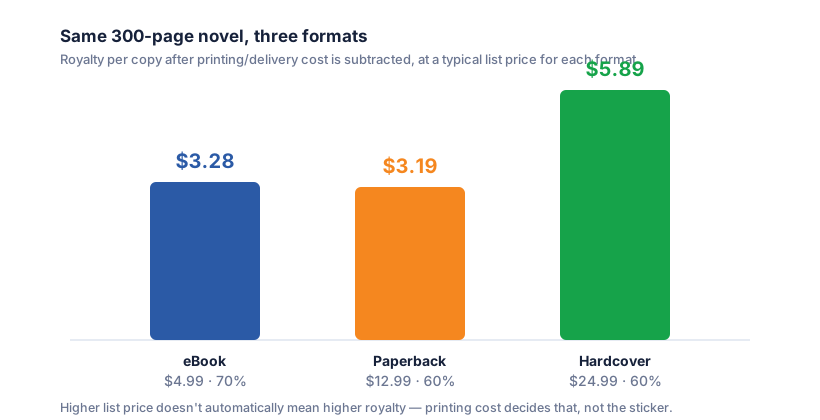
Two things worth sitting with. The eBook and the paperback pay almost the same amount per copy here, despite a list price two and a half times higher on the paperback — printing cost eats most of the paperback's higher price. And the hardcover, priced at a genuine premium, is the only format where the extra list price clearly outruns its extra production cost.
None of this means one format is "better." It means the three formats are different businesses stapled to the same book, and treating them as one number is how authors end up pricing paperbacks on a hunch.
The cliff that isn't limited to eBooks
The 70%-to-35% eBook cliff at $12.99 gets a lot of attention. Print has its own version, smaller in absolute terms but proportionally just as sharp, right at that $9.99 tier line.
Take the same 300-page paperback and drop it one cent under the threshold:
| List price | Tier | Royalty |
|---|---|---|
| $9.98 | 50% | $0.39 |
| $9.99 | 60% | $1.39 |
A single cent of list price is worth a dollar of royalty. If a paperback's "natural" price in your niche sits right around $9.99, that's not a rounding decision — it's the most consequential cent in your whole pricing sheet.
Expanded Distribution: a third, lower rate
There's a rate below both of these that only paperbacks are eligible for. Tick Expanded Distribution and copies sold through that channel — bookstores, libraries and academic suppliers, rather than Amazon directly — pay a flat 40% of list price minus printing cost, regardless of your list price tier. Hardcovers aren't eligible for Expanded Distribution at all.
It's not a bad deal — those are sales you otherwise wouldn't get, and Amazon's Expanded Distribution page is upfront that the lower cut reflects the wholesale discount those channels expect. But it's worth knowing your "paperback royalty" isn't one number if you've enabled it: most of your copies pay 50–60%, and a minority pay a flat 40%, depending on where they sold.
So why publish in all three?
Given eBook and paperback often land within a dollar of each other per copy, and hardcover printing cost is steep, the case for multiple formats isn't really about which one pays best per unit. It's three separate things:
- Different buyers. Some readers won't touch an ebook; some only buy hardcover as gifts. You're not competing with yourself for the same sale, you're catching demand your single-format competitors miss entirely.
- Extra shelf space. Each format gets its own three category picks in KDP — more on using that properly here — so a book in all three formats can occupy up to nine category placements instead of three.
- A higher "from" price on the listing. Amazon's product page shows pricing across formats together, and a hardcover option sitting above your paperback and ebook makes both of the cheaper formats look like the sensible choice, a framing effect that costs you nothing to set up.
The practical takeaway
Don't price a paperback by picking a number that "feels premium." Run the actual formula, check which side of the $9.99 tier line you land on, and only then decide if the extra list price is worth it against what the format actually nets you. The eBook pricing decision has a whole article behind it because it deserves one; print deserves the same five minutes of arithmetic, not a guess copied from the paperback sitting next to yours on the shelf.
One field on that same screen deserves a minute of its own: unlike the eBook, every print format needs an ISBN, and free-from-KDP versus buying your own is locked once you publish.
There's a fourth format this comparison doesn't cover, because it's priced and paid on an entirely different basis: audio. If you're weighing whether to add it, the Virtual Voice and ACX routes pay 40% and 50% respectively — but only one of them costs money to produce.
If you're pricing across formats for a niche you're researching rather than a book you've already written, KDP Metric's Niche Grade reads list prices straight off the search results page, so you can see what paperback and ebook prices are already working before you commit to either.
Add to Chrome — it's free