
Articles › BSR & Sales Data
Do KDP Pre-Orders Help Your Launch? The Sales Rank Timing That Decides It
Published 3 August 2026 · KDP Metric team
Here's a story that repeats itself in author forums every week. Someone sets up a three-month pre-order, works hard through the window, collects a respectable pile of orders, and waits for release day. Release day arrives. The rank barely moves. No badge, no visible surge, nothing that looks like the launch they'd been building toward.
Nothing went wrong. The rank had already happened — it just happened in instalments, spread thinly across those three months, while the KDP dashboard showed a flat and discouraging zero. Pre-orders on Amazon work almost exactly opposite to the way most launch advice assumes, and the difference is worth understanding before you commit to a date you can't move.
The sentence in KDP's own documentation that settles it
Search for how Amazon pre-orders affect rank and you'll find two confident, contradictory answers. One says pre-orders accumulate and all land as day-one sales, producing the spike that drives you up the charts. The other says they count as they come in. They can't both be right, and one of them is very popular.
Amazon's own help page for Kindle eBook Pre-Order is not ambiguous. Pre-orders, it says, "will contribute toward sales rank and other Kindle Store merchandising even before your eBook's released."
Before released. Not banked, not held, not consolidated. Each pre-order does its work on the rank at the moment a reader places it.
The "they all count on launch day" version isn't invented out of nothing — it's true of traditional publishing, where first-week print sales are what feed the bestseller lists, and it's true of some other retailers. It is simply not how the Kindle Store works, and applying it to a KDP ebook launch leads to a plan built on a spike that was never going to arrive.
Two clocks: rank is spent as you go, money lands all at once
The genuinely confusing part is that pre-orders don't run on one clock, they run on two, and the two disagree.
Rank moves during the pre-order window. Every order nudges the book up on the day it's placed, then that nudge decays like any other sale.
Royalties do not. KDP's pre-order pricing and reports page states that "your pre-order sales data will not appear in other reports until after your eBook is delivered to customers on its release date." After release, those units surface in the Prior Months' Royalties report under a transaction type called, straightforwardly, "Pre-order."
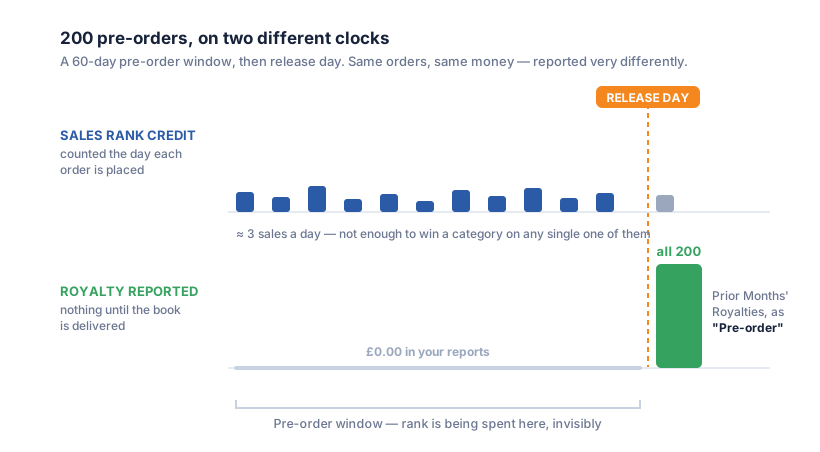
So during your pre-order period the reports show nothing at all, while the thing you actually care about for visibility is quietly being consumed. Authors reasonably read that empty dashboard as "no sales" and conclude the pre-order failed. Then release day produces no fireworks either, because the fireworks were let off one at a time over eight weeks.
What that does to a bestseller badge
This is where the timing stops being trivia and starts costing you something concrete.
A category bestseller badge is won by out-selling the other books in that category on a given day. It's a daily contest, not a cumulative total. The number of daily sales required is often surprisingly small in a narrow category — but it's still a daily number.
Take 200 pre-orders. Spread across a 60-day window, that's a little over three sales a day: pleasant, and almost certainly not enough to win anything. Concentrated into a single launch day, 200 sales would top a great many Kindle sub-categories outright.
Same readers, same money, wildly different visibility outcome. And the pre-order length is the lever that decides which one you get.
 Add to Chrome — it's free
So when is a pre-order actually worth it?
Plenty of the time. The mechanism isn't bad, it's just widely misunderstood, and there are real cases where spreading rank across a window is the right trade.
Series continuation is the strongest case by a distance. When a reader finishes book three at midnight, you want book four to be orderable at 12:01. A live pre-order page turns the end of one book into a sale on the next, at the single moment of peak intent. No launch-day spike is worth more than that, and the sales are ones you would otherwise simply lose.
You need a live page to point at. Ads, newsletter links, podcast appearances, cover reveals, a Goodreads listing — none of them work against a URL that doesn't exist yet. A pre-order page is live and orderable as soon as Amazon's review is done, which turns every bit of pre-launch promotion into something that can actually convert instead of a promise to remember later.
Steady visibility beats a spike for some books. A spike is worth chasing when a badge or a chart position is the goal. If you're building a slow-burn non-fiction title, being consistently present in a category for two months may serve you better than one loud day followed by silence.
It locks readers in at today's price. Amazon's pre-order price behaviour is generous to readers and therefore to conversion: lower the price during the window and Amazon retroactively charges the lower price to everyone who already ordered. Raise it, and prior customers still pay the lower price they ordered at.
The penalty most authors don't read until it's too late
Pre-orders are the one release option on KDP that carries a real, documented punishment, and it's much harsher than people expect.
You must upload your final manuscript and submit more than 72 hours before the scheduled release date. Miss that deadline and the pre-order is cancelled — and, in Amazon's words, that "will prevent you from setting up a pre-order on any eBook for one year."
Not that book. Any book. The ban follows your whole account for twelve months.
The same one-year ban applies if you cancel a scheduled pre-order outright. There is exactly one piece of slack in the system: you may delay a release once, by up to 30 days, as a one-time exclusion that applies across your entire catalogue. Delay a second time and you're back to the one-year ban, and you also lose the ability to extend release dates on any other pre-orders you have running.
A few other limits worth knowing before you plan around them:
- Pre-orders are for new eBook titles only — you can't retro-fit one to a published book, and public domain titles aren't eligible.
- You can have a maximum of 10 simultaneous pre-orders at a time.
- A pre-order can be set up to one year ahead of the release date.
The practical reading of all this: only put a book on pre-order when the manuscript is genuinely finished, or close enough that a 72-hour deadline three months out holds no fear for you. A pre-order set up to force yourself to finish is a bet with a twelve-month downside.
Pre-order and "Schedule a Release" are not the same thing
These get used interchangeably in author advice and they're entirely different mechanisms, available on different formats.
| Pre-order | Schedule a Release | |
|---|---|---|
| Formats | eBooks only | Print only (paperback, hardcover) |
| Detail page | Live as soon as review completes | Hidden until release day |
| Can readers order early? | Yes | No |
| How far ahead | Up to one year | 5 to 90 days |
| Final file deadline | 72 hours before release | 5 days before release |
| Penalty for slipping | One-year pre-order ban | None |
The key consequence: there is no pre-order for paperbacks or hardcovers on KDP. Scheduling a print release just hides the page until the day. That's useful for coordinating a simultaneous multi-format launch, and it carries none of the pre-order risk, but it accumulates nothing — no early orders, no early rank.
It also means that if you run a long ebook pre-order alongside a scheduled paperback, you're deliberately splitting your launch: the ebook rank drains away across the window while the paperback does nothing at all until the day.
How to decide, in one pass
- Manuscript not finished? No pre-order. The 72-hour deadline and the one-year ban make this the only sensible answer.
- Next book in an established series? Set the pre-order up as early as it's safe to, and put the link in the back of the previous book. This is what pre-orders are genuinely excellent at.
- Chasing a category badge or a chart position? Keep it to a week or two, or skip it. Don't spread the sales you're relying on to win a single day's contest.
- Debut with no audience yet? A long pre-order mostly buys you an empty page and a deadline. Spend the time building the list instead, then launch into it.
- Non-fiction building slowly? A longer window is defensible — sustained presence is worth more to you than one loud day.
Whichever you choose, work out beforehand what the pre-order is for. "Everyone does a pre-order" is how authors end up with a diluted launch, an empty dashboard for two months, and a deadline that can cost them the option for a year. Used deliberately — for series links, for a promotable live page, for locking in a price — it's a good tool. It just isn't the launch-day amplifier it's usually sold as.
Add to Chrome — it's free