
Articles › BSR & Sales Data
Kindle Unlimited and KDP Select: The Exclusivity Decision, With the Actual Numbers
Published 27 July 2026 · KDP Metric team
Every new KDP author hits the same checkbox within about ten minutes of uploading their first manuscript, usually without much idea of what it commits them to. Enrol in KDP Select? It sounds like a loyalty scheme. It's actually an exclusivity contract with a 90-day clock on it, and it changes both how you get paid and how you should read everyone else's sales data.
This isn't an argument for or against. It's the mechanics, sourced from Amazon's own help pages, plus the part almost nobody mentions: what Kindle Unlimited does to the numbers you're using to pick your next book.
What you're actually agreeing to
KDP Select enrols the digital edition of one title, for a 90-day term that renews automatically unless you switch it off. For those 90 days that ebook has to be exclusive to Amazon — you can't sell it on Apple Books, Kobo, Google Play, Barnes & Noble, or from your own website.
Three details that catch people out:
- It's per-book, not per-account. You can have three titles in Select and two wide. Nothing forces consistency.
- It only binds the ebook. Your paperback, hardcover and audiobook are untouched, and you can sell those anywhere.
- Renewal is the default. The term rolls over on its own. If you want out, you have to go and untick it before the term ends, and you serve out the remaining days regardless.
How Kindle Unlimited actually pays
This is the part most explanations skip past, and it's where the money is.
KU subscribers pay a monthly fee to Amazon, not to you. Amazon puts a pot of money aside each month — the KDP Select Global Fund — and announces the total after the fact. Every enrolled author gets a slice of that pot in proportion to their share of all pages read that month.
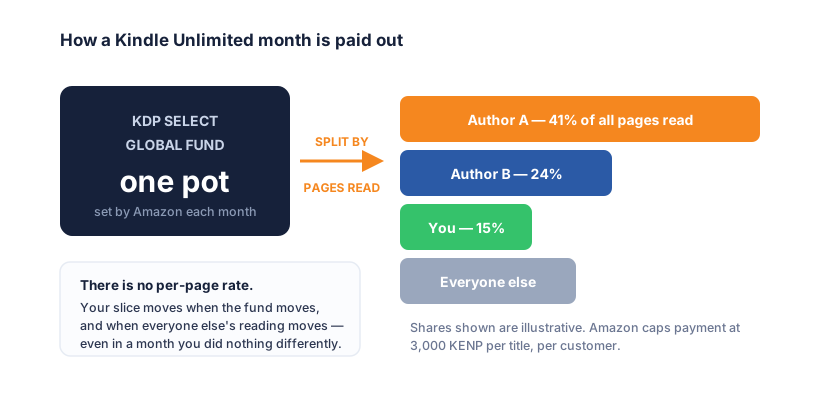
Amazon's own worked example: if the fund were $10 million and 100 million pages were read across the whole programme, an author with 10,000 pages read would receive $1,000. Divide it out and that's a cent a page — the real figure has historically run a good deal lower, and it wobbles month to month because both halves of the fraction move.
That's the single most important thing to understand about KU income. There is no per-page rate. There's a pot and a division. If Amazon grows the fund, your pages are worth more; if the programme grows faster than the fund, they're worth less, and you did nothing differently.
A few more mechanics worth knowing:
- Pages are counted in KENP (Kindle Edition Normalized Pages), Amazon's own standardised page measure — currently KENPC v3.0 — calculated from default formatting so a large-font children's book can't out-earn a novel by padding.
- You're paid for a maximum of 3,000 KENP per title, per customer. Enormous omnibus editions hit a ceiling.
- Borrows count toward Best Sellers Rank. A borrowed book registers as customer activity the same way a purchase does.
That last point is the one that leaks into your research, and we'll come back to it.
The promotions, and the one choice you have to make
Select gives you two promotional tools, and Amazon's rule is that you may run one type or the other during a given 90-day term, not both.
Free Book Promotion — up to 5 free days per 90-day term, usable all at once or split up. Unused days don't carry over. Free downloads don't count toward your paid rank; the free chart is a separate list.
Kindle Countdown Deal — a timed discount of up to 7 days. The book must have been enrolled in Select for at least 30 days, and its list price must sit in the eligible band ($2.99–$24.99 on Amazon.com, £1.99–£15.99 including VAT on Amazon.co.uk). The genuinely useful part: you keep your normal royalty rate on the promotional price, so a book that drops to $0.99 during a countdown still earns at 70% rather than falling to the 35% band it would normally sit in at that price.
That last clause is the strongest single argument for Select for a lot of authors, and it's worth reading twice before you dismiss the programme.
 Add to Chrome — it's free
What KU does to the data you're researching
Here's where this stops being an admin decision and starts being a research one.
Because borrows count toward rank, the BSR of a book in a KU-heavy genre is measuring a blend of purchases and borrows — and those two things pay very differently. A £0.99 romance sitting at #4,000 might be selling a handful of copies a day and being borrowed many times over. Another book at the same rank in a non-fiction niche with almost no KU presence might be earning several times as much per unit of rank.
So when you convert a rank into money using any of the standard rank-to-sales tables (ours included), you are implicitly assuming paid purchases. In a KU-dominated niche that assumption overstates the revenue a given rank represents, sometimes badly. It doesn't make the rank wrong — it's still a perfectly good measure of demand and momentum. It just means "this niche's page-one books average #12,000" translates into different money depending on how KU-soaked the niche is.
The practical rule: read rank as demand, not as revenue, until you know the KU mix.
Spotting a KU niche before you commit
You can tell fairly quickly, and it doesn't take a tool — though it's exactly the sort of counting a tool should do for you.
Open the search results for your niche and look at the price column. A wall of £0.99 and £2.99 titles from independent authors is the signature of a KU-first market. Those prices don't make sense as a standalone business; they make sense as a way of getting borrowed. Open three or four of the top books and look for the "Read for Free" / Kindle Unlimited badge on the product page. If most of page one carries it, you're in a KU niche and you should plan accordingly.
The reverse pattern — £4.99 to £12.99 prices, traditional publisher imprints, no KU badges — tells you the readers in that niche buy books. Different economics, different book length, different launch strategy.
So is it worth it?
Honestly, it depends on a single question: does your genre's audience live in Kindle Unlimited?
In romance, and much of thriller and fantasy, subscribers are a large share of the readership, borrows are a large share of the activity, and going wide means giving up most of the market's actual reading. Select is close to a default there.
In non-fiction — business, professional, hobbyist, reference — buyers usually want to own the book, prices are higher, and per-sale royalty at £7.99 dwarfs what page reads bring in. The exclusivity buys you much less.
And there's a version of this argument that has nothing to do with genre: if you're publishing your first book and have no mailing list, no audience and no other channel producing sales, the thing you give up by going exclusive is largely theoretical. Select's discoverability is a real asset when you have nothing else. You can always take the book wide in 90 days when the answer is clearer.
What you shouldn't do is tick the box because it was there, then spend a year wondering why your rank looks healthy and your bank balance doesn't. The programme is a trade — visibility and borrows for exclusivity and a variable per-page rate — and it's a good trade in some niches and a poor one in others. Check which one you're in before you sign up for the next 90 days.
Add to Chrome — it's free