
Articles › Comparisons
Audiobooks: Virtual Voice or ACX — and the Royalty Change With a Year-End Deadline
Published 12 September 2026 · KDP Metric team
Audio is the format most self-published authors skip, and the reason has always been the same: a human narrator costs somewhere between a good cover and a small car, paid before a single copy sells.
Two things changed that calculation this year. KDP added a route that costs nothing to produce, and Audible rewrote its royalty rates upward — with a deadline attached that applies to any title already on the platform. The deadline is the part to deal with first, because it has an expiry date on it and the rest of this article doesn't.
First, the deadline: Audible's new royalty model
On 26 May 2026, ACX — the Audible-owned platform most independent authors use to publish audiobooks — moved to a new royalty model. The headline is straightforward and it's an increase:
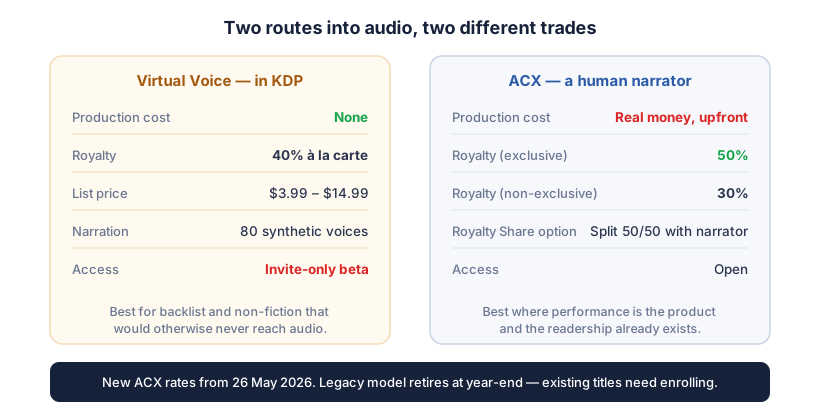
- Exclusive distribution: 50%, up from the legacy 40%
- Non-exclusive distribution: 30%, up from the legacy 25%
New titles published on the new model take effect immediately, and titles claimed after 26 May 2026 are automatically on the new terms. For titles you already had on ACX before that date, the new rate applies from the 1st of the month following your enrolment.
Here's the part that needs action rather than reading. ACX states that the legacy model is being discontinued by the end of 2026, and that rights holders must enrol existing titles by year-end to continue distribution. If you have audiobooks sitting on ACX from a previous year and you haven't touched the account since, that is a live administrative deadline on your own back catalogue, not a marketing email to ignore.
How the new model actually pays
The rate is the simple half. The calculation underneath it changed too, and it's worth understanding because it alters which books do well.
Under the new model, royalties on membership listening are based on Member Value — the price of the listener's monthly membership plan, minus taxes and fees. Where a member uses additional credits, that credit value is added in. That total is then divided proportionally among the titles that member actually engaged with, weighted by each title's à la carte price, and your share is multiplied by your royalty rate.
For non-member purchases and member cash purchases, the calculation is unchanged.
The practical shift is that creators now earn across all plan types and consumption methods — whether a listener spends a credit or reaches your book through the all-you-can-listen catalogue. Under the old arrangement, catalogue listening was a materially different proposition. If your audiobook lives mostly in subscriber listening rather than outright sales, this is the change that matters most to you.
Route one: Virtual Voice, inside KDP
Virtual Voice is Amazon's synthetic-narration route, and it sits inside KDP rather than ACX — you start from an eligible eBook already on your Bookshelf.
What it offers:
- No production cost. This is the entire argument. There is no narrator to pay, no studio, no per-finished-hour fee.
- 40% royalty on à la carte sales. Titles enrolled in KDP Select also draw from a separate Audible Plus fund, distinct from the Kindle Unlimited pot that pays your eBook page reads.
- List price between $3.99 and $14.99.
- 80 voices, including American, British and Australian English, Latin American and Castilian Spanish, French and Italian — and you can assign different voices per chapter, which matters more than it sounds for multi-POV fiction.
- Preview and edit the narration before you publish rather than shipping blind.
- Distribution on Amazon, Audible, Alexa and through Amazon Music Unlimited.
And the constraint that decides it for most people right now: it remains an invite-only beta, launched to the US marketplace. You don't apply and get approved on demand — you join the beta interest list and wait for an invitation, and no amount of wanting it moves that along.
 Add to Chrome — it's free
Route two: ACX, with an actual human
ACX is where you go for human narration, and it offers three ways to pay for it:
Pay for Production. You hire the narrator outright, at an agreed per-finished-hour rate, and keep the full royalty afterwards. Highest upfront cost, highest long-run share, and the only option where you owe nobody anything once the book is made.
Royalty Share. No upfront payment; you split the royalties with the producer 50/50 for the life of the contract. Attractive when cash is the constraint, expensive over a long-lived backlist title, since you're giving away half of every sale indefinitely rather than paying once.
Royalty Share Plus. The middle path: the narrator receives a per-finished-hour rate that helps cover their production costs and shares royalties, splitting the royalty earnings 50/50 with you.
Note how the arithmetic lands. A Royalty Share audiobook on exclusive distribution earns 50%, of which you keep half — an effective 25% — against Virtual Voice's 40%, which isn't split with anyone. The higher headline rate on ACX only reaches your account in full if you paid for production up front, which is precisely the cost Virtual Voice removes. So the comparison isn't "50% versus 40%"; it's "50% minus whatever you paid or promised a narrator, versus 40% and nothing."
Which route for which book
Virtual Voice suits a backlist title you'd never otherwise put into audio, non-fiction where the information matters more than the performance, and any book where the realistic alternative is no audiobook at all. Zero downside risk, zero cash outlay, and a format you weren't otherwise selling in. The blocker is access, not economics.
ACX suits a book with a proven readership, character-driven fiction where performance is the product, and anything where you're willing to spend real money on the expectation of real returns. It's also the only route if your book needs a narrator who can act.
Neither is worth doing on a book that doesn't sell in text. Audio doesn't rescue a title with a weak cover, a flat blurb or no readership — it just adds a second format nobody is looking for, at additional cost or additional effort. The stuck-book diagnostic is the right thing to run first.
One disclosure question, answered
Because Virtual Voice is synthetic narration, authors reasonably ask whether it triggers KDP's AI content disclosure. Keep the two things separate: the disclosure requirement covers AI-generated content in the book you publish — text, images and translations. Virtual Voice is Amazon's own narration feature applied to a book you already wrote, and Amazon labels those audiobooks as virtual-voice narrated in its own store. If AI wrote the manuscript underneath it, that's the disclosable thing, and it was disclosable before any audiobook existed.
What to do this month
- If you have any pre-May-2026 title on ACX, check its royalty model and enrol it before year-end. This is the only item here with a deadline.
- If you're on ACX and not exclusive, do the arithmetic again — 30% non-exclusive against 50% exclusive is a wider gap than the old 25/40 split, and wide enough to be worth re-running against what your non-Audible channels actually earn.
- If Virtual Voice appeals, join the beta interest list, because that's the only route in.
- Price the audiobook deliberately, the way you'd price anything else — $3.99 and $14.99 are very different propositions, and the same royalty-band thinking that governs eBook pricing applies to a format where the listener's alternative is a credit they've already paid for.
Audio is a genuinely additive format: it reaches people who will never read your book, in contexts where reading isn't possible. But it's still downstream of whether the book has an audience at all. KDP Metric's free Niche Grade reads the competition on any Amazon search page, so you can judge that before committing a narrator's fee to finding out.
Add to Chrome — it's free