
Articles › BSR & Sales Data
When KDP Actually Pays You — and the Form That Quietly Expires
Published 9 September 2026 · KDP Metric team
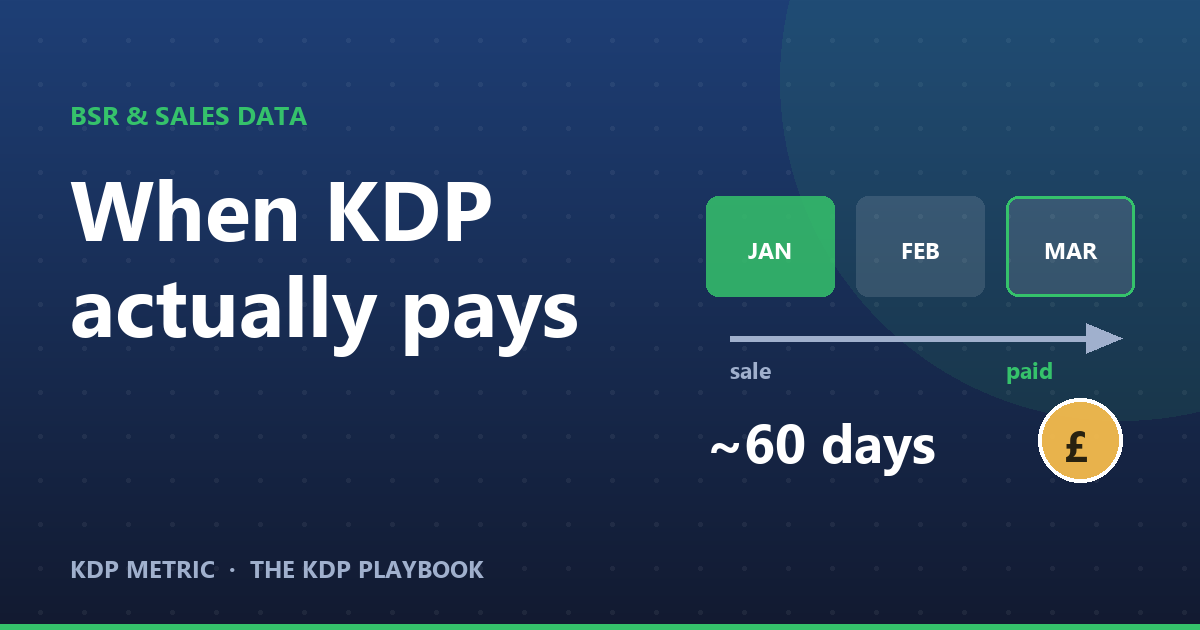
Every other article on this site is about earning the royalty. This one is about the gap between earning it and having it — a stretch of about two months, governed by rules most authors only learn by being surprised.
There are two surprises in particular. The first is the lag: a sale you make today is not money you see this quarter. The second is quieter and more expensive — a tax form that works perfectly for three years and then silently stops, at which point a quarter of your income starts disappearing without a single notification. Here's the whole mechanism, sourced from KDP's own payment and tax documentation.
The 60-day rule
KDP pays monthly, approximately 60 days after the end of the month in which the sale was reported. That phrasing is precise and worth unpacking, because the clock starts at the end of the sale's month, not at the sale.
A book sold on 3 January and a book sold on 29 January are in the same batch. January closes, 60 days run, and payment lands around the end of March. The same sale made two days later, on 1 February, isn't paid until roughly the end of April.
Expanded Distribution is slower: 90 days rather than 60. That's the channel reaching bookshops, libraries and other retailers, and it's paperback-only — as covered in the ISBN article, hardcover isn't eligible for it at all. If you use it, part of your income runs permanently a month behind the rest.
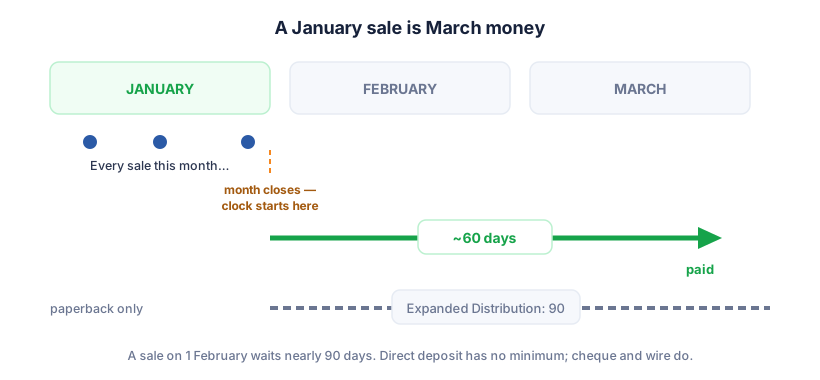
The practical consequence is for planning, not accounting. A launch in November does not pay for Christmas. A book that starts selling in earnest in March produces its first meaningful payment at the end of May. Any author treating KDP income as a monthly wage needs roughly a quarter of runway before the payments catch up to the sales.
Thresholds: why EFT is the only sensible choice
KDP pays by electronic funds transfer, wire, or cheque depending on your bank's location, and the difference between them is larger than it looks.
EFT / direct deposit has no minimum threshold. KDP's threshold documentation is unambiguous: you're paid electronically in full no matter how small the amount. Earn £3.40 in a month and £3.40 arrives.
Cheque and wire have minimums — generally the equivalent of $100 in the marketplace's local currency, with variations including ¥10,000 for Japanese wire transfers and 1,000 MXN for Mexico. Fall below the threshold and you aren't paid; instead KDP keeps a running total and pays once the accumulated balance clears the minimum. Some marketplaces, Poland and Sweden among them, don't support wire or cheque at all.
Delivery time compounds the difference:
- Direct deposit: 1–5 business days after the payment date, 7–10 for Indian banks
- Wire: 5–10 days
- Cheque: up to 30 days after the payment date
So the worst configuration — cheques, in a marketplace where you earn slowly — can mean a sale in January paid at the end of March and physically arriving in late April, assuming you cleared $100 at all. The best configuration is direct deposit, and setting it up for every marketplace you earn in is the single highest-value ten minutes in your KDP account settings.
 Add to Chrome — it's free
Currency: the quiet leak
You earn in the currency of the store where the book sold. A US sale earns dollars; a German sale earns euros.
If the currency you earn in differs from the currency of the account you're paid into, KDP converts it using a third-party exchange service, with the conversion fee included in the rate you receive. That's not a line item you'll see; it's baked into the amount.
The way to avoid it is to be paid in the currency of the sale where your banking allows — KDP supports direct deposit in the sale currency, which removes the conversion entirely. For an author selling meaningfully in both the US and UK stores, holding an account that can receive both dollars and pounds is worth more than it sounds, particularly at the volumes where a percentage point or two on every payment starts to be real money.
The 30% that isn't inevitable
This is the part that costs non-US authors the most, and it's entirely avoidable.
US tax law requires Amazon to withhold 30% of US-source royalty payments to non-US publishers by default. Not 30% of profit — 30% off the top of your US earnings, before anything reaches you.
You reduce it by completing KDP's tax interview, which you do online inside your KDP account, at no cost. If your country of tax residence has an income tax treaty with the United States, the interview lets you claim the treaty rate instead of the statutory 30%. Many treaties reduce the rate on royalties substantially; some reduce it to zero. KDP doesn't publish a country-by-country table and neither will this article, because rates are set by treaty and change — the IRS publishes the authoritative table of tax treaty rates, and that's the one to check against your own circumstances.
To claim treaty benefits you need a tax identification number. Either a US TIN — an ITIN for individuals, an EIN for non-individuals — or, if you don't have one, the income tax identification number issued by your own country's tax authority, which KDP accepts for treaty claims. That second route is the one most individual authors outside the US now take, and it removed the old requirement to apply to the IRS before you could stop losing a third of your American income.
The expiry trap
Here's the one almost nobody knows, and the reason this article exists.
A W-8 form expires on the last day of the third succeeding calendar year from the date you signed it. Sign in 2026 and it lapses at the end of 2029. When it does, your withholding reverts to the statutory 30% — automatically, on every subsequent payment.
Nothing about that failure is loud. The books keep selling, the reports keep reporting, the payments keep arriving. They're just smaller, by an amount you'd have to go looking for to notice, and they stay smaller until you go back into the tax interview and re-file.
Set a calendar reminder the day you complete the interview, for three years out, and check the W-8 review page in your KDP account periodically against it. That's the whole fix: a reminder now against a silent pay cut later.
Year-end paperwork
KDP issues year-end tax forms through your account, and they're the basis of what you declare wherever you're resident. Two things to line up before you need them: make sure the tax details in your account match the entity that will actually be declaring the income — sole trader, limited company, however you're structured — and understand that KDP reports on its payment dates, not on your sale dates. That 60-day lag means December's sales generally land in the following tax year's records, which is worth knowing before you try to reconcile a sales dashboard against a tax form and find they disagree by two months of income.
The five-minute version
- Set up direct deposit for every marketplace you earn in. No threshold, fastest delivery, no reason not to.
- Complete the tax interview, and claim treaty benefits with your own country's tax ID if you don't have a US one.
- Diary the W-8 expiry — the last day of the third calendar year after signing.
- Get paid in the sale currency where your banking allows it, to skip the conversion spread.
- Plan around 60 days, and 90 for Expanded Distribution.
None of that earns you a single extra reader, which is presumably why it goes undone for years at a time. It just stops a working book from paying less than it earned. Once it's set up, the leverage moves back where it belongs — onto what the book actually nets per copy, and whether the niche can support enough copies to matter. KDP Metric's free Niche Grade answers the second half of that on any Amazon search page, before you write the book rather than after.
Add to Chrome — it's free