
Articles › BSR & Sales Data
Countdown Deal or Free Days? You Only Get One Per Term
Published 7 September 2026 · KDP Metric team
Enrol a Kindle eBook in KDP Select and you get two promotional tools attached to each 90-day term. Almost every author knows they exist. Rather fewer know the rule that makes the choice matter: you can run one type or the other during a term, not both.
So this isn't a menu, it's a fork. Pick the wrong one for the book you have and you've spent the term's promotional allowance on the weaker instrument. Here's exactly what each one does, from KDP's Countdown documentation and its Free Book Promotions page, and the reasoning that should decide it.
The context: what you already paid for these
Both tools are benefits of KDP Select, which means you've already paid for them with digital exclusivity — 90 days where that eBook can't be sold anywhere but Amazon. That's the real price of these promotions, and it's worth remembering when weighing whether either is worth running at all.
Note also that Select covers the eBook only. Neither promotion touches your paperback or hardcover, which keep selling at their normal price throughout.
Free Book Promotions: five days, every store
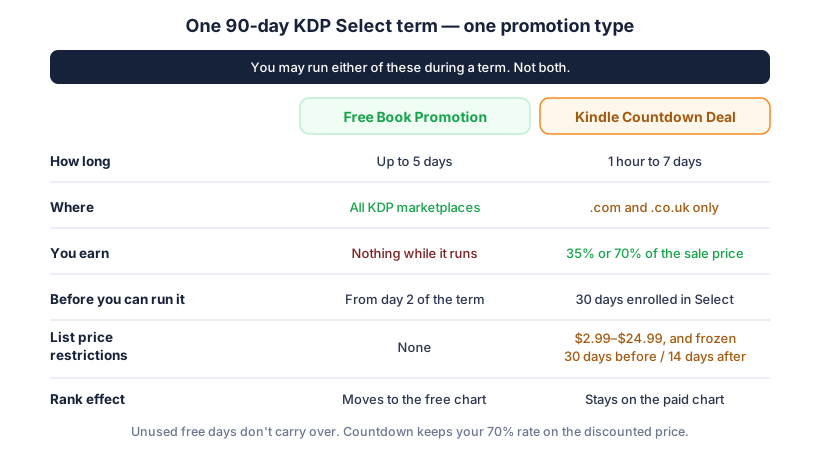
The simpler of the two. You make the eBook free for up to 5 days out of each 90-day term, and the rules are permissive:
- Available in all KDP marketplaces — not just the US and UK.
- You can run all five days consecutively, one at a time, or in any combination across the term.
- Schedule at least one day in advance. The earliest a promotion can start is the second day of your Select term.
- Unused days don't carry over. Finish a term having used two, and the other three are gone.
- Cancelling takes up to several hours to take effect, so a change of mind isn't instant.
What you get is reach. What you give up is revenue: KDP is explicit that you earn no royalties while the promotion runs. A thousand free downloads pays exactly nothing.
The rank mechanics are their own subject and catch people out. Free books sit on a separate bestseller list from paid titles — a #1 Free ranking is a different chart from a #1 Paid ranking, and conflating them is the single most common piece of self-published misreporting you'll see. When the promotion ends, the book moves back to the paid rankings, and that transition can take up to 24 hours to settle.
Kindle Countdown Deals: seven days, two stores, tighter rules
A Countdown Deal discounts rather than zeroes the price, with a visible countdown clock and the original price shown struck through. The rules are considerably stricter:
- Eligibility: the title must have been enrolled in KDP Select for at least 30 days. A book you enrolled last week can't run one.
- Marketplaces: Amazon.com and Amazon.co.uk only. No Germany, no Canada, no Australia.
- Price band: list price must be $2.99–$24.99 on .com, or £1.99–£15.99 including VAT on .co.uk.
- Discount size: at least $1.00 / £1.00 below list, with a maximum of 5 price increments during the deal.
- Duration: from 1 hour to 7 days, as one continuous run.
- Frequency: one per 90-day term.
- Scheduling: at least 24 hours in advance, and once it's inside that 24-hour window or already running, you can't edit or cancel it.
 Add to Chrome — it's free
The royalty rule that decides most of it
Here's the detail that makes Countdown Deals worth understanding properly, and it's a genuine quirk of the system rather than a marketing line.
Normally your royalty rate is a function of your list price: the 70% band runs from $2.99 to $12.99 on Amazon.com, and price below or above it and you drop to 35%. That's covered in full in the pricing article, and it's the reason $0.99 books earn so little per copy.
During a Countdown Deal, KDP applies your regular royalty rate — 35% or 70% — to the promotional price. So a book listed at $4.99 keeps its 70% entitlement while actually selling at $0.99, rather than dropping to the 35% a $0.99 list price would normally command.
It's worth doing that arithmetic properly rather than taking it on faith, because the two royalty options are calculated differently. The 70% rate deducts a delivery cost based on file size ($0.15/MB on Amazon.com); the 35% rate deducts nothing. For a 2MB novel, delivery comes to $0.30:
| What you do | Rate | Royalty per copy sold at $0.99 |
|---|---|---|
| Permanently reprice to $0.99 | 35% | $0.35 |
| Countdown from a $4.99 list price | 70% | $0.48 |
So the Countdown route earns roughly 40% more per copy here — real money, but not the doubling it's sometimes described as. And the gap depends entirely on your file size, because delivery cost is the variable: a light 0.5MB file earns $0.64 on the same Countdown (an 83% advantage), while a heavily illustrated book with a large file can see the advantage shrink to almost nothing.
Check your own delivery cost before assuming this favours you. KDP shows it on the pricing page, already converted into money.
Against a Free Book Promotion, though, the comparison needs no arithmetic at all: free days pay nothing per copy. Any Countdown revenue beats that on a per-copy basis by definition. The question is only whether the volume a free promotion generates is worth more to you than the revenue a discounted one does.
The price lock nobody reads until it bites
One Countdown rule catches authors mid-plan: your digital list price can't change for 30 days before and 14 days after the promotion.
That's a 44-day window, minimum, in which your pricing is frozen around the deal. If you were planning to test a price change, run a launch discount, or reprice after a cover refresh, the Countdown has to be scheduled around that, not into it. Work backwards from the deal date before you commit to it.
So which should you run?
Choose free days when the objective is reach rather than revenue: you're launching book one of a series and the entire point is to feed readers into read-through; you're building a mailing list; you want volume in a market outside the US and UK, where Countdown isn't available at all; or the book is priced below $2.99 and therefore Countdown-ineligible anyway.
Choose a Countdown Deal when the book already sells: it has reviews, a rank history, and a readership that a discount can activate. You keep 70% on every discounted copy, the deal stays on the paid charts rather than jumping to the free list, and the visible countdown clock creates a deadline that a permanently cheap book never has.
Consider running neither if the book's problem isn't price. A free promotion on a book with a weak cover and three reviews produces a spike of downloads by people who'd have taken anything free, no read-through, and no lasting rank. Promotions amplify a book that's working; they don't fix one that isn't, which is what the 10-point diagnostic is for.
Reading the results without fooling yourself
Whichever you run, judge it on the week after, not the day of. Free downloads are not sales and the free chart is not the paid chart. A Countdown's real test is whether paid rank settles higher than it started once the deal ends and the 24-hour rank transition has worked through. And with pre-orders, discounts and promotions all interacting with rank on different clocks, it's worth knowing how sales rank timing actually works before you attribute a change to the thing you just did.
KDP Metric tracks any book's rank and price over time for free, which is the least self-deceiving way to read a promotion: a trend line either moved or it didn't, and you're comparing it against the fortnight before rather than against how the launch felt.
Add to Chrome — it's free