
Articles › KDP Updates
KDP Changes in 2026: The New Weekly Title Limit, the $12.99 Royalty Band, and What to Do Now
Published 8 October 2026 · KDP Metric team
KDP's rules didn't change much for most of a decade. In the last sixteen months they've changed half a dozen times — and two of the biggest landed in the last three months. Some of what's circulating about them is wrong, and the advice many authors are still following was written before any of it.
This is the short, sourced version: what changed, the exact wording where it matters, and what to do about it. Everything below comes from Amazon's own KDP announcements and help pages, checked on 8 October 2026.
1. A weekly limit on new titles (September and October 2026)
This is the one most likely to change how you plan the next year, and it arrived in two steps.
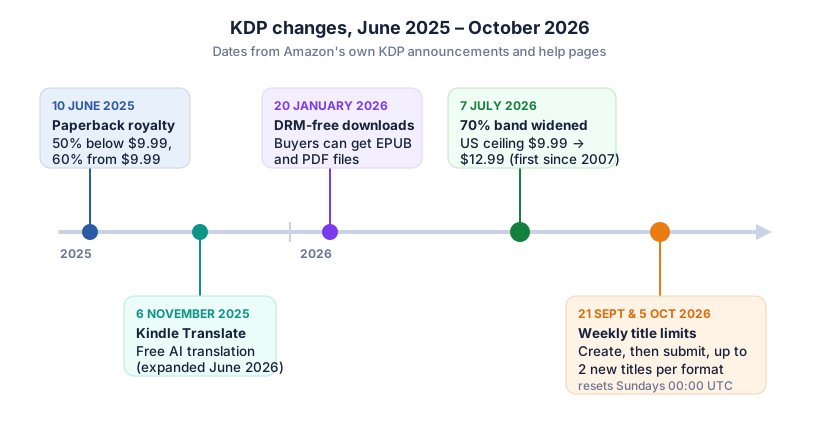
From 21 September 2026, you can create up to 2 new titles per format per week. The formats are counted separately — eBook, paperback and hardcover — so in one week you could create two eBooks, two paperbacks and two hardcovers. The allowance resets every Sunday at 12:00 AM UTC. Amazon's stated reason, in its announcement on the KDP Community, is "to help maintain a positive publishing experience for all authors".
From 5 October 2026, a second limit sits on top: you can submit up to 2 new titles per format each week for publication. The same announcement was updated to add it, and the wording is precise:
- It counts the first time you submit a title for publication — and that includes titles you'd saved as drafts.
- Updates to titles you've already submitted don't count. Changing the price, the description or the keywords on a live book is unaffected.
- Existing and published titles aren't touched by either limit.
Who this actually affects
For most novelists, nothing changes: two new eBooks a week is more than almost anyone writes. It bites in four places.
Launching a series all at once. Rapid-release is still possible — it just takes more weeks. A five-book series with eBook and paperback editions now needs at least three weeks of submissions, not one afternoon. Plan the order so book one is live first.
Back catalogues coming to KDP. If you're moving twenty titles from another platform, that's ten weeks per format at full speed. Prioritise by what sells, not alphabetically.
New editions. Anything you create as a new title in your Bookshelf draws on the allowance — including a new edition you've had to create because you changed something that forces a new ASIN. Before you create one, check whether you really need to; many changes can be made in place.
Low-content and puzzle publishers. This is where it bites hardest. A business built on publishing dozens of near-identical interiors a week no longer works on one account.
One open question: Amazon hasn't said whether a Kindle Translate edition counts as a new title for these limits. Until it does, assume it might, and leave room in your week.
2. The 70% royalty band now goes to $12.99 (7 July 2026)
On 7 July 2026, the ceiling of the 70% eBook royalty band rose from $9.99 to $12.99 on Amazon.com, with matching changes in the other stores — the first change to that band since 2007. The current ranges, from KDP's eBook list price page:
| Store | 70% band |
|---|---|
| Amazon.com | $2.99 – $12.99 |
| Amazon.co.uk | £1.77 – £12.99 |
| Germany, France, Spain, Italy, Netherlands | €2.69 – €12.99 |
| Amazon.ca | C$2.99 – C$12.99 |
| Amazon.com.au | A$3.99 – A$15.99 |
| Amazon.co.jp | ¥250 – ¥1,650 |
| Amazon.in | ₹99 – ₹599 |
| Amazon.com.br | R$5.99 – R$31.99 |
| Amazon.com.mx | MX$34.99 – MX$199.99 |
Three conditions still apply, and they're the ones calculators most often get wrong:
- The 70% is worked out on the price without VAT, after the delivery fee. KDP's formula is 70% × (list price − VAT − delivery cost). In the EU, Australia and Japan the tax is inside your list price, so the royalty per sale is noticeably lower than "70% of the price".
- Your eBook must be at least 20% cheaper than any print edition of the same book to qualify.
- In Japan, Brazil, Mexico and India, 70% is only paid to eBooks enrolled in KDP Select.
What to do about it
If you priced at $9.99 only because it used to be the ceiling, you now have room — particularly for practical non-fiction, where buyers compare you with traditionally published books at $11–$15. And if anything in your catalogue sits between $10 and $12.99 at 35%, it may now qualify for 70% without a price change. The cliff hasn't gone, it has moved: $13.00 still drops you to 35%. The full working is in How to Price a Kindle Book, and our free royalty calculator applies the current bands, VAT and delivery fees for any store.
 Add to Chrome — it's free
3. DRM-free books can be downloaded as EPUB and PDF (20 January 2026)
Since 20 January 2026, people who buy a DRM-free Kindle book can download it as an EPUB or PDF and read it on any device. Amazon's notice adds the detail that matters for older books: if you take no action, the DRM status of previously published titles doesn't change, but EPUB and PDF downloads are not switched on for existing DRM-free titles. To allow them, you re-select "No, do not apply Digital Rights Management" on the book's eBook Content page and confirm the new checkbox. Changes can take up to 72 hours.
Kindle Unlimited borrowers can't download the files, even from a DRM-free book. The full decision — and why the setting is less permanent than people think — is in Should You Apply DRM to Your Kindle Book?
4. Changes from 2025 that still catch people out
Paperback royalties have two tiers (since 10 June 2025). Paperbacks and hardcovers pay 60% at or above a threshold — $9.99 on Amazon.com — and 50% below it, minus printing. A paperback at $9.98 earns ten points less royalty than one at $9.99. A lot of pricing advice online still assumes a flat 60%. Our royalty comparison has the numbers.
Kindle Translate is free (since 6 November 2025, expanded 30 June 2026). Amazon's AI translation now covers English to and from Spanish, German, French, Italian and Portuguese, for eBooks only and by invitation through your Bookshelf. What it does and doesn't do.
Audiobooks on ACX have a deadline (new model since 26 May 2026). Not KDP itself, but most KDP authors with audiobooks use it: Audible's ACX moved to a new, higher royalty model, and says the old one ends with 2026 — existing titles must be enrolled by year-end to keep being distributed. The details, and how Virtual Voice compares.
AI disclosure still applies. Not new, but now more relevant than ever: if text, images or translations were generated by AI, KDP asks you to say so when you publish or update. Where Amazon draws the line.
What's not changed — despite what you may have read
A few claims are going round that we couldn't find in any Amazon announcement or help page. Treat them with caution until Amazon says otherwise:
- That Amazon now automatically assigns extra categories beyond your three. KDP's help still describes choosing up to three categories per format.
- That ranking now depends on a new "dwell time" factor. Amazon doesn't publish its ranking factors, and nothing official says this.
- Exact figures for the old title limit, as above.
If a "new KDP rule" comes with no link to kdp.amazon.com or the KDP Community, it's a rumour until proven otherwise.
A checklist for this month
- Check every eBook priced between $9.99 and $12.99 (or the local equivalent). Is it on the royalty you think it is?
- Plan new releases in weekly batches of two per format, with the most important book first. Remember drafts count when they're first submitted.
- Decide DRM deliberately for any older DRM-free titles you want buyers to be able to download.
- Check paperbacks priced just under the threshold ($9.99 on Amazon.com). A cent can be worth ten points of royalty.
- Audiobooks on ACX from before 26 May 2026? Enrol them in the new royalty model before the end of the year. It's the only item here with a hard deadline.
- Bookmark the sources. KDP's help pages and the KDP Community announcements are where changes are actually published — usually days before the blog posts.
KDP Metric 1.1.3 already applies all of these rules: the Pro royalty checker uses the new bands, VAT and the KDP Select rule, and the launch checklist includes the weekly title limit. Each rule in the extension carries the date it was last checked against KDP's own pages.
Add to Chrome — it's free